

Peças para Britador Cônico
Peças para Britador Cônico | Mantos, Revestimentos e Reposição | ATF
Peças para britadores cônicos: mantos, revestimentos da bacia, cones de alimentação e reposição em aço manganês (Mn14-Mn22). Envie modelo e cavidade.
Complete Wear Part Solutions for Cone Crushers
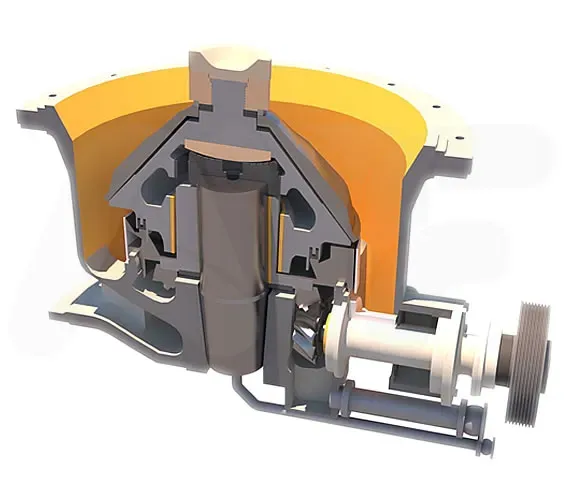
Cone crushers reduce material through compression between a gyrating mantle and a stationary concave (bowl liner). An eccentric assembly drives the main shaft in a circular gyratory motion, progressively crushing material as it moves down through the chamber. This compression-based mechanism produces consistent cubical product shape with predictable gradation — making cone crushers the standard for secondary, tertiary and quaternary crushing in hard rock mining, aggregate production and mineral processing.
Every component in a cone crusher — from the mantles and concaves that form the crushing chamber to the eccentric bushings that create the gyratory motion — operates as an integrated system. Liner profile geometry, manganese grade, CSS setting and mechanical spare condition all interact to determine throughput, product quality and operating cost. ATF engineers and manufactures the complete range of cone crusher wear parts and mechanical spares to OEM specifications, with manganese grades optimised for your specific rock type and crushing duty.
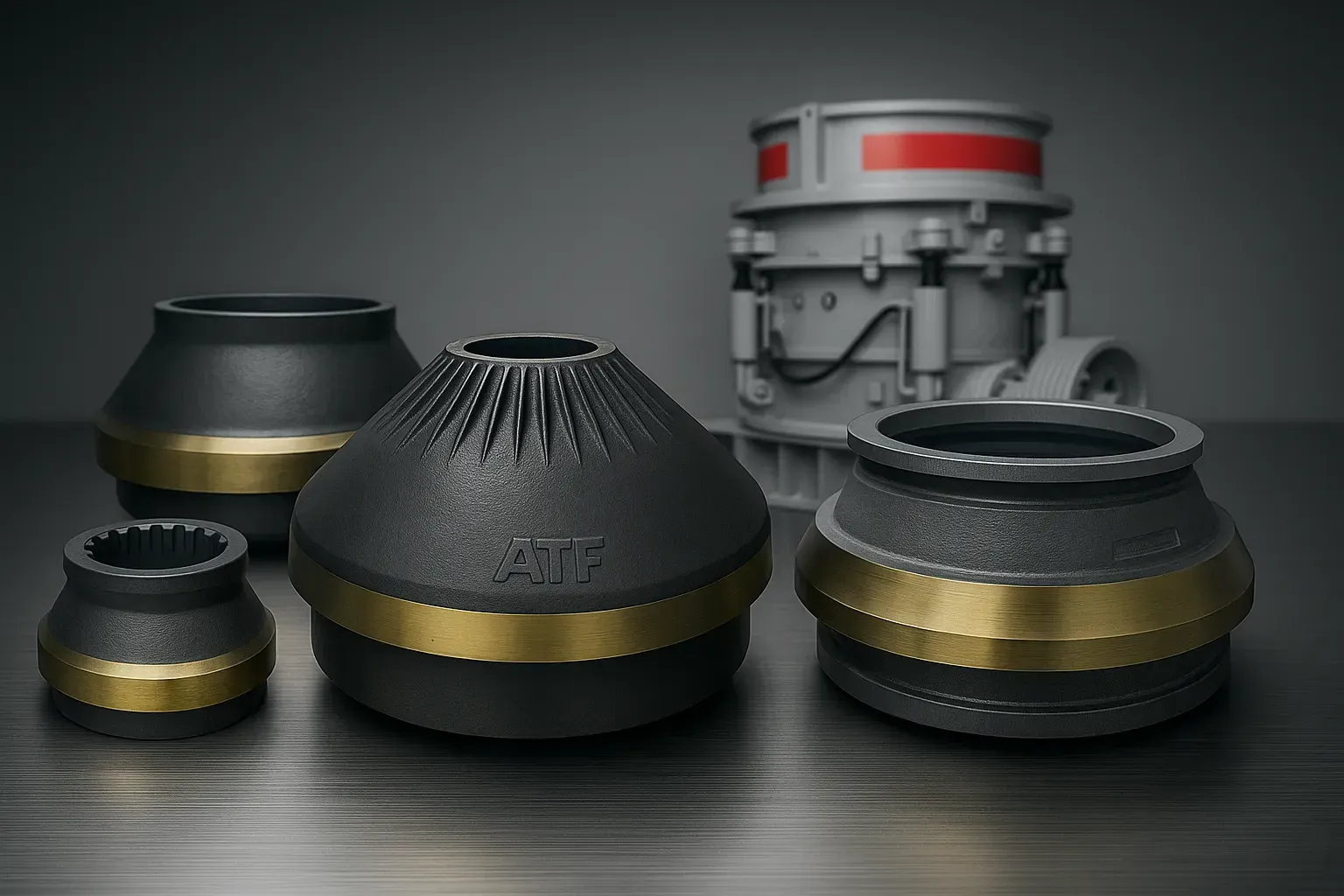
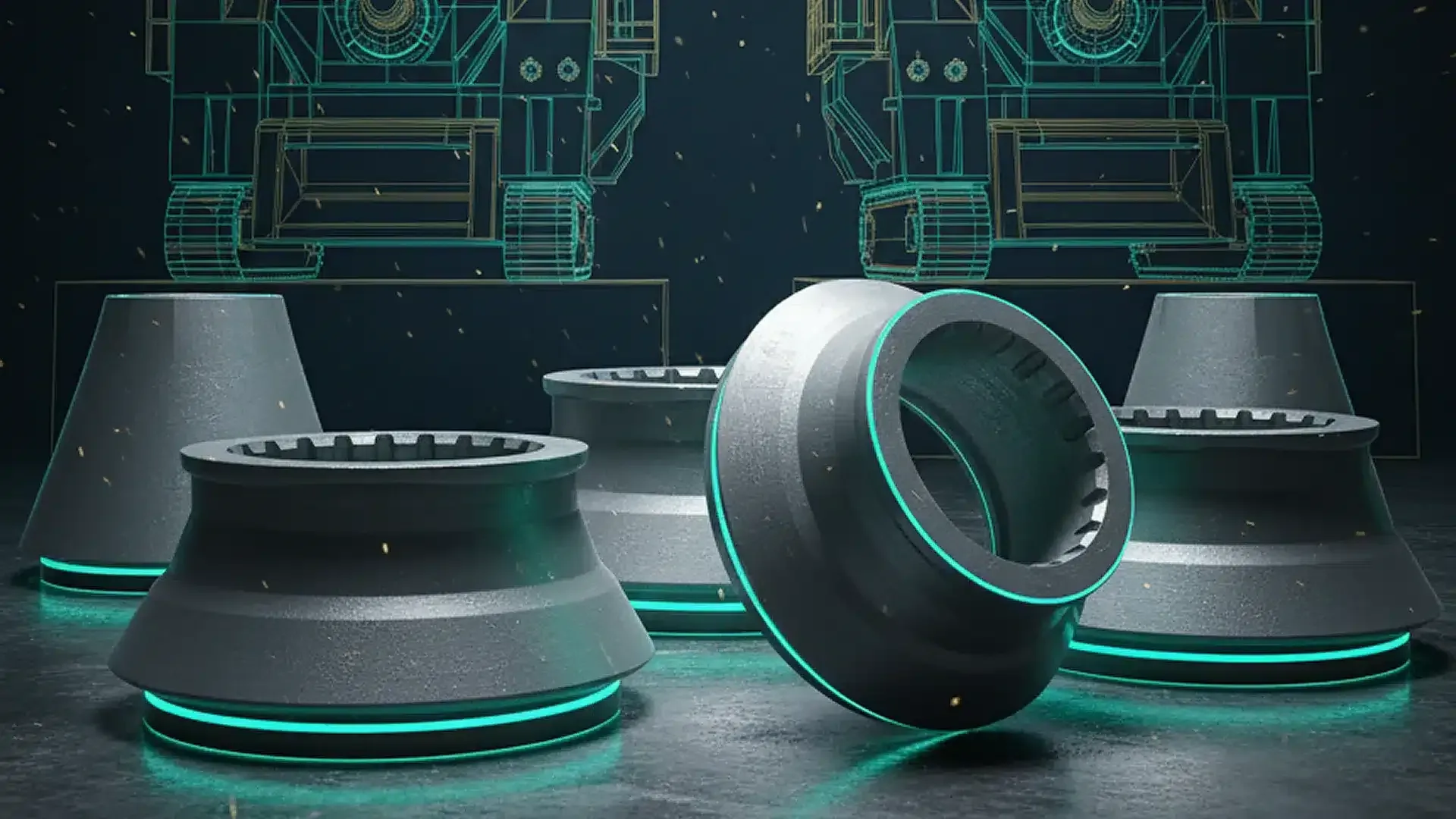
ATF cone crusher liners ready for dispatch — mantles and concaves in Mn13–Mn22 manganese steel, profile-matched to OEM chamber geometry.
Cone Crushing Mechanism
Understanding how each component contributes to the compression crushing process explains why liner profile selection, CSS control and mechanical spare condition directly affect product quality, throughput and operating cost.
Feed Entry & Distribution
Material enters the crusher from the top and falls onto the feed cone, which distributes it evenly around the full circumference of the crushing chamber. Even distribution is critical — one-sided feeding causes asymmetric liner wear that reduces chamber efficiency and liner life. The feed cone also protects the head nut from direct material impact.
Compression Crushing
The eccentric assembly drives the main shaft and mantle in a gyratory motion. As the mantle approaches the concave, material trapped between the two surfaces is compressed and fractured. The progressively narrowing chamber profile provides staged reduction — coarse crushing at the top, fine crushing at the bottom. Each revolution of the eccentric produces one complete compression cycle.
Product Discharge
When the mantle moves away from the concave (open-side of the cycle), crushed material falls by gravity toward the discharge opening. The closed-side setting (CSS) — the minimum gap between mantle and concave — determines the maximum product particle size. Material that hasn't been reduced sufficiently is re-crushed in subsequent compression cycles until it passes through the CSS.
Cone Crusher Wear Parts & Mechanical Spares
A cone crusher requires eight categories of wear and structural parts. Each component page provides detailed material options, OEM compatibility tables and application-specific guidance.
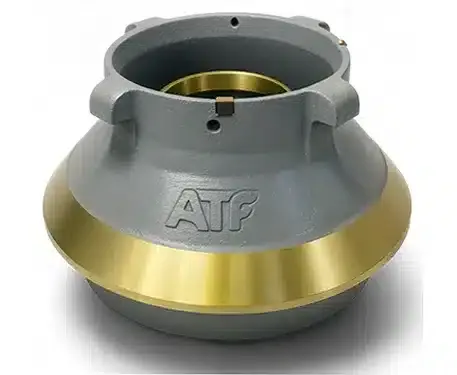
Cone Liners (Mantles & Concaves)
The primary wear parts in every cone crusher. The mantle (inner rotating liner) and concave (outer stationary liner) form the crushing chamber. Profile geometry, alloy grade and cavity selection directly determine product gradation, throughput and wear cost per ton.
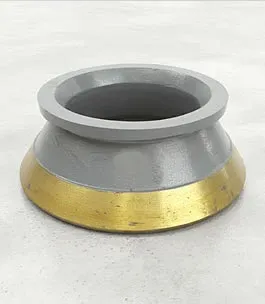
Feed Cones
Mounted above the mantle to distribute incoming feed evenly around the crushing chamber circumference. A worn or damaged feed cone causes one-sided feeding that creates uneven liner wear, reduces throughput and generates excessive vibration.
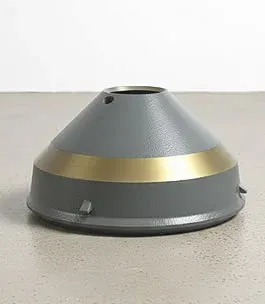
Torch Rings
Sacrificial manganese wear rings positioned between the mantle and the main frame. Torch rings absorb abrasive contact that would otherwise damage the crusher's main shaft or frame surfaces — components that are expensive and time-consuming to repair.
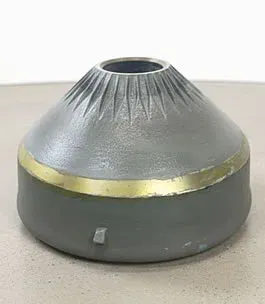
Lock Nuts & Adjustment Rings
Precision-machined threaded components that secure the bowl liner (concave) in position and control the closed-side setting (CSS). Thread wear or damage prevents accurate CSS adjustment, leading to inconsistent product size and potential liner loosening during operation.
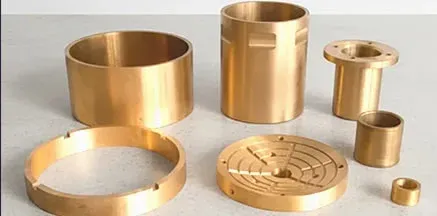
Eccentric Assemblies
The eccentric assembly creates the gyratory motion that drives the crushing action. Bronze bushings, the eccentric shaft and gear assemblies must maintain precise clearances — worn eccentrics cause inconsistent throw, reduced capacity and accelerated bearing failure.
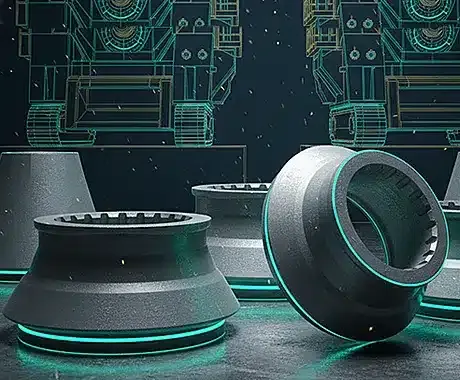
Socket Liners
Bearing surfaces that support the main shaft within the crusher frame. Socket liners are precision-bored to maintain correct shaft alignment and eccentric geometry. Worn sockets allow shaft movement that cascades into uneven liner wear and mechanical damage.
Frame Liners & Arm Guards
Bolt-on manganese protectors for the main frame, spider arms and discharge area. Frame liners absorb abrasive material contact in the discharge zone — without them, the cast frame erodes, requiring costly weld repair or frame replacement.
Additional Spares
Dust seals, Belleville springs, hydraulic cylinders, head ball assemblies and bronze bushings. These support components are critical for safe operation — worn seals introduce contamination, weak springs reduce tramp release protection, and damaged hydraulics prevent CSS adjustment.
Manganese Grade Selection for Cone Crusher Liners
Manganese grade is the most important decision affecting cone crusher liner economics. The correct grade depends on the impact energy in your application — determined by feed material hardness, feed size, CSS and crusher speed. Using a higher manganese grade than the application needs wastes money without improving wear life. Using too low a grade results in premature wear and frequent liner changes.
Mn13Cr2 Manganese Steel
Mn13Cr2 (standard)
Primary and secondary cone crushing of hard, abrasive rock with high impact energy
Baseline
Limitation: Does not work-harden sufficiently in low-energy tertiary applications — glazes and wears rapidly
Mn18Cr2 Manganese Steel
Mn18Cr2 (high-manganese)
High-impact secondary crushing, large feed sizes, hard rock (granite, basalt, quartzite)
1.2–1.5× Mn13 in high-impact applications
Limitation: Higher cost than Mn13 — only justified where impact energy is sufficient to activate the extra manganese
Mn22Cr2 Manganese Steel
Mn22Cr2 (ultra-high manganese)
Extreme duty: large primary cones, very hard feed material, high reduction ratios
1.5–2× Mn13 in extreme-impact applications
Limitation: Premium cost — only economical when high impact energy fully work-hardens the extra manganese content
Mn + TiC Composite
Mn14/Mn18 base + TiC inserts (2800 HV)
Abrasive secondary and tertiary applications where maximum wear life justifies higher cost
2–3× standard manganese
Limitation: TiC inserts can spall under extreme point-load impact — not recommended for primary crushing with large uncontrolled feed
Quick Selection Framework
Standard secondary/tertiary crushing (limestone, gravel)? → Mn13Cr2 — the industry standard for moderate-impact applications
Hard rock secondary crushing (granite, basalt, quartzite)? → Mn18Cr2 — higher work-hardening capacity for higher-impact conditions
Extreme duty primary cone crushing with very hard feed? → Mn22Cr2 — maximum toughness for extreme reduction ratios
Maximum wear life in abrasive secondary/tertiary applications? → Mn + TiC composite for 2–3× standard manganese life
Not sure which grade applies? Contact ATF with your crusher model, feed material, feed size and target CSS — we'll recommend the optimal manganese grade and cavity profile.
Compatible Cone Crusher Brands & Models
ATF manufactures aftermarket mantles, concaves and mechanical spares to OEM dimensional and profile specifications. All liners are verified against original cavity drawings before production. Profile tolerance: ±2 mm, weight: ±2%, bore/thread dimensions: ±0.5 mm.
Metso
HP100, HP200, HP300, HP400, HP500, HP800, GP100, GP200, GP300, GP500
Nordberg HP and GP series — most common globally
Sandvik
CH420, CH430, CH440, CH660, CH860, CH870, CS420, CS430, CS440, CS660
Hydrocone CH and CS series
Terex / Cedarapids
TC1000, TC1150, TC1300, TC36, TC51, MVP280, MVP380, MVP450
Including Cedarapids and legacy models
Kleemann
MCO 9, MCO 11, MCO 13
Wirtgen Group mobile cone crushers
FLSmidth
Raptor 200, Raptor 300, Raptor 400, Raptor 900, XL300, XL400, XL900
Raptor and XL series high-performance cones
Trio / Weir
TP260, TP350, TP450, TP600, TC36, TC51, TC66, TC84
Trio stationary and Weir Minerals models
Don't see your crusher model? ATF maintains patterns and profile drawings for 50+ cone crusher models including discontinued and legacy equipment. Send your crusher nameplate or part number for confirmation.
Verify Your ModelNeed Cone Crusher Parts Fast?
Stock mantles, concaves and common spares ship within 1–2 weeks. Send your crusher model, cavity type and part requirements for a same-day quotation.
Cone Crusher Maintenance Best Practices
Disciplined maintenance extends liner life, prevents unplanned downtime and protects the crusher's mechanical components — eccentric bushings, main shaft and frame — from damage caused by worn liners or neglected support systems.
Every Shift
- Check crusher oil temperature, pressure and flow — abnormal readings indicate bearing or seal issues
- Visual inspection of feed distribution — material should flow evenly around the chamber circumference
- Listen for abnormal sounds: metallic hammering, knocking or grinding indicates tramp metal or liner contact
Weekly
- Measure closed-side setting (CSS) and compare to target — adjust if product gradation has drifted
- Inspect the feed cone and hopper for wear, cracking or material build-up affecting distribution
- Check tramp release system: hydraulic pressure, accumulator pre-charge and spring condition
Monthly
- Measure liner wear at multiple points around the chamber — uneven wear indicates feed distribution problems
- Inspect torch ring condition — replace before it wears through to the main frame
- Check hydraulic oil condition and filter elements — contaminated oil accelerates seal and cylinder wear
At Liner Change
- Inspect main shaft, head and frame contact surfaces for scoring, erosion or corrosion
- Check eccentric bushing clearances against OEM specification — replace if worn beyond tolerance
- Verify adjustment ring threads and lock nut condition — worn threads prevent accurate CSS control
- Replace all dust seals — reusing worn seals allows fine material ingress into bearing areas
- Re-calibrate CSS position indicators after new liner installation
Typical CSS Ranges by Application
| Application | Typical CSS | Cavity Type | Product Size |
|---|---|---|---|
| Secondary Crushing | 19–38 mm | Coarse | 25–50 mm |
| Tertiary Crushing | 10–19 mm | Medium | 13–25 mm |
| Quaternary / Fine | 6–13 mm | Fine / Extra-Fine | 8–16 mm |
| Manufactured Sand | 3–8 mm | Extra-Fine | 0–5 mm |
CSS ranges are indicative. Actual settings depend on crusher model, liner condition and feed characteristics. Always refer to your OEM manual for model-specific recommendations.
Common Cone Crusher Problems & Solutions
Recognising wear patterns and operational symptoms early prevents costly damage to the main shaft, eccentric assembly and crusher frame. Contact ATF technical support if you need help diagnosing an issue.
Uneven Liner Wear
Probable Causes
- Asymmetric feed distribution — material favouring one side of the chamber
- Worn or damaged feed cone not distributing material evenly around the mantle
- Choke feed not maintained — crusher running partially empty creates localised wear
Corrective Actions
- Check and repair feed distribution: chute alignment, feed cone condition, hopper design
- Ensure choke feeding — the chamber should be full at all times during operation
- Rotate or replace feed cone if worn, cracked or deformed
Liner Cracking or Spalling
Probable Causes
- Inadequate crusher backing compound — liners not fully supported against the frame
- Incorrect alloy for the application — too brittle for the impact conditions
- Tramp metal events exceeding the tramp release system's response time
Corrective Actions
- Ensure correct backing compound is applied with zero voids during liner installation
- Review alloy grade selection — increase manganese content for higher-impact applications
- Inspect and maintain tramp release system: hydraulic pressure, accumulator, springs
Packing / Bridging in Chamber
Probable Causes
- CSS set too tight for the feed material — particularly problematic with wet or clay-bearing feeds
- Insufficient crusher speed for the feed characteristics
- Worn liners creating a chamber profile that traps material instead of releasing it
Corrective Actions
- Open CSS to allow material to pass — especially in wet or sticky conditions
- If clay content is high, consider liner profiles designed for contaminated feeds
- Replace worn liners — the chamber geometry changes as liners wear, affecting flow
Excessive Vibration
Probable Causes
- Unbalanced or eccentric wear on the mantle creating asymmetric loading
- Worn eccentric bushings allowing excessive shaft play
- Foundation bolts loosened by repeated tramp metal events or operational shock
Corrective Actions
- Inspect liner wear pattern — replace if significantly uneven
- Check eccentric bushing clearances and replace if beyond tolerance
- Re-torque all foundation bolts and inspect concrete base for cracking
Reduced Throughput or Oversized Product
Probable Causes
- Liner wear has opened the CSS beyond target — product is coarser than specification
- Chamber profile worn flat — loss of progressive reduction geometry
- Incorrect liner cavity selection for the feed size and desired product
Corrective Actions
- Adjust CSS to compensate for liner wear — measure and reset to target
- Replace liners if the profile is worn flat or beyond effective adjustment range
- Review cavity selection with ATF — coarse, medium and fine profiles are available for each model
Frequently Asked Questions
Answers to common questions about cone crusher parts, manganese grade selection, maintenance and ordering. Can't find what you're looking for?
Contact Our TeamWhat is the difference between a mantle and a concave (bowl liner)?
How do I choose the correct manganese grade for my cone crusher?
What is closed-side setting (CSS) and why does it matter?
How often should cone crusher liners be replaced?
Are ATF cone crusher parts compatible with OEM equipment?
What information does ATF need to quote cone crusher parts?
What is crusher backing compound and why is it important?
What is the typical lead time for cone crusher parts?
Ready to Optimise Your Cone Crusher Performance?
ATF engineers respond within 24 hours with manganese grade recommendations, cavity profile verification and competitive pricing for your specific crusher and application.
Request a Free QuoteMaximize a Vida Útil do Revestimento
Composto de Apoio ATF Maxtor
Nosso composto de apoio epóxi 100% sólido elimina espaços entre revestimentos e corpos de britador, absorve vibrações e estende a vida útil das peças de desgaste. Não inflamável, mistura fácil, sem equipamentos especiais.
Solicite um Orçamento Gratuito Hoje
Nossa equipe de engenharia responde em 24 horas com especificações detalhadas, recomendações de materiais e preços competitivos.