
Revestimentos da Estrutura | Peças para Britador Cônico | ATF

Peças para Britador Cônico

Revestimentos da Estrutura | Peças para Britador Cônico | ATF

Revestimentos da estrutura e protetores de braço para britadores cônicos em aço manganês. Protegem a estrutura principal do contato abrasivo.

Mantos Revestimentos da Bacia Côncavos

Especificações principais

Material Grades
Mn13Cr2, Mn14-Mn18, AR400/AR450, CCO overlay
Hardness Range
170-450 HB (Mn/AR) / 55-63 HRC (CCO surface)
Mounting Options
Bolt-on (countersunk) or weld-on
Thickness Range
15-60 mm depending on position and model
OEM Brands
Metso, Sandvik, Terex, Telsmith, Symons, FLSmidth
Standards
ASTM A128 (Mn), ASTM A532 (Cr iron), ASTM A514 (AR plate)

Material Options for Frame Liners

Frame liner material selection depends on the position and wear mechanism. Impact zones benefit from manganese steel; sliding wear areas may use harder materials.

Mn13Cr2 Manganese Steel

Dureza:170-200 HB (work-hardens)
Aplicação:Spider arm guards, impact zones
Notas:Excellent impact resistance

Mn14-Mn18 Manganese Steel

Dureza:200-240 HB (work-hardens)
Aplicação:General frame protection
Notas:Good balance of impact and abrasion resistance

AR400/AR450 Plate

Dureza:360-450 HB
Aplicação:Lower frame, sliding wear areas
Notas:Cost-effective for moderate wear positions

Chromium Carbide Overlay (CCO)

Dureza:55-63 HRC surface
Aplicação:Severe sliding abrasion areas
Notas:Weld overlay on mild steel backing

Note: Material selection should account for the specific wear mechanism at each position. Contact ATF for application recommendations.

Frame Liners

Frame Liners: Protecting Your Investment

Frame liners and arm guards are sacrificial wear components that protect the main frame casting from direct contact with the abrasive material flow passing through the cone crusher. The main frame is one of the most expensive and longest-lead-time components in a cone crusher, typically representing 25-35% of total machine replacement value with manufacturing lead times of 8-16 weeks for new castings. Damage to the main frame from abrasive wear is extremely costly to repair, often requiring specialized field welding with preheat and controlled interpass temperatures followed by machining to restore critical seating surfaces, and can sideline the machine for weeks during the repair process. Frame liners manufactured from manganese steel (ASTM A128), AR plate (ASTM A514), or chromium carbide overlay (CCO) absorb this wear while preserving the structural integrity and dimensional accuracy of the underlying frame casting. Available in thicknesses from 15 mm to 60 mm depending on position and expected wear rate, these liners are designed for periodic replacement as part of routine maintenance.

Different positions on the cone crusher frame experience distinctly different wear mechanisms that require position-specific material selection for optimal cost-effectiveness. Spider arm guards in the upper frame are subjected to high-energy impact from material bouncing off the mantle and material fragments ejected upward during the crushing cycle, making manganese steel (Mn13Cr2 or Mn14Cr2 per ASTM A128) the preferred choice due to its exceptional toughness and work-hardening response under impact loading. Lower frame liners in the material discharge zone experience predominantly sliding abrasion as crushed product flows downward under gravity, and harder materials such as AR400/AR450 plate (360-450 HB) or chromium carbide overlay (CCO, 55-63 HRC surface hardness) deliver significantly longer wear life in these positions. Transition zones between impact and abrasion areas benefit from intermediate materials. ATF supplies frame protection components for all major cone crusher models with engineering support to recommend optimal material grades for each position based on your specific operating conditions.
Frame Protection
Manganese Steel
Model-Specific
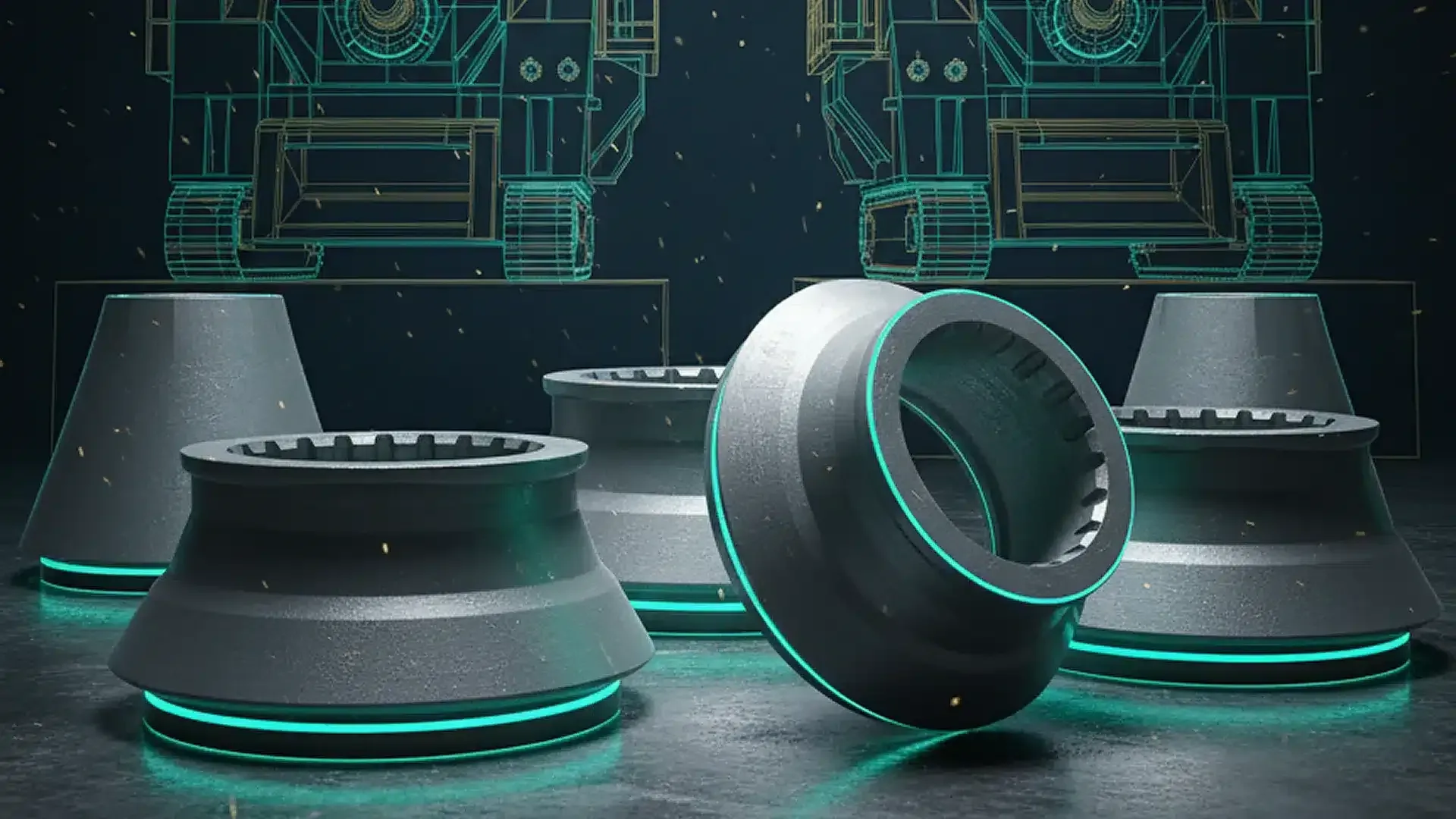
Cone crusher frame liners in manganese steel manufactured by ATF

Frame liners protect the main frame casting from material impact and abrasion in the discharge zone

Key Features of ATF Frame Liners

Position-Specific Design

Liner profiles matched to specific frame positions. Correct fit ensures proper protection and material flow.

Wear-Resistant Materials

Manganese steel for impact areas, AR plate for sliding wear, and combination materials for mixed wear zones.

Secure Mounting

Bolt-on and welded options with countersunk fasteners where needed to prevent interference.

Segmented Construction

Multi-piece designs for easy replacement of worn sections without removing complete liner sets.

Custom Fabrication

Custom liners available for modified frames or unusual wear patterns. Send drawings or worn samples.

Thickness Options

Standard and heavy-duty thickness to match wear rates with maintenance intervals.

Need Frame Protection Components?

Send your crusher model for a quote on frame liners matched to your specific configuration.

Request a Quote

OEM Compatibility

ATF manufactures frame liners and arm guards for all major cone crusher brands with correct profiles and mounting configurations.

Metso

  • HP Series (HP100-HP800)
  • GP Series (GP100-GP550)

Sandvik

  • CH Series (CH420-CH895)
  • CS Series
  • H-Series Hydrocone

Terex / Cedarapids

  • TC Series
  • Kodiak Series

Telsmith

  • T-Series
  • H-Series

Symons

  • Standard (2'-7')
  • Shorthead (2'-7')

FLSmidth

  • Raptor Series
Perguntas frequentes

Frame Liners Perguntas frequentes

Encontre respostas para perguntas comuns sobre frame liners materiais, seleção, manutenção e pedidos. Não encontrou o que procura?

Contatar nossa equipe
How often should frame liners be inspected?
Frame liners should be visually inspected during every scheduled maintenance stop, with a thorough dimensional assessment at each liner change interval. Visual inspection involves checking for wear-through (any area where the frame casting is visible through the liner), loose or missing fasteners, cracked or broken liner segments, and deformation that could alter material flow patterns. Thickness measurements using ultrasonic gauges at predetermined reference points provide quantitative wear rate data for predictive replacement scheduling. Many experienced operators establish a formal inspection protocol that documents liner condition each time the crusher is accessed for any maintenance activity, creating a wear history database that enables accurate prediction of replacement timing. In applications processing highly abrasive materials such as granite, quartzite, or material with high silica content, frame liners in high-wear zones should be inspected more frequently than the standard liner change interval. Any liner section showing less than 25-30% of original thickness, loose mounting hardware, or cracks should be replaced immediately regardless of scheduled maintenance timing.
What happens if frame liners are not replaced?
Allowing frame liners to wear through and expose the main frame casting to direct material contact initiates a cascading damage sequence that becomes increasingly expensive to arrest. Initial frame wear creates shallow grooves in the casting surface that concentrate material flow, accelerating localized wear. Once grooves form, material velocity increases in the channels, and wear depth progresses at an accelerating rate. Minor frame wear can be repaired by field welding using compatible consumables (typically AWS E7018 or specialized cast steel electrodes) with proper preheat to 150-250 degrees Celsius depending on the frame material, controlled interpass temperature, and slow cooling under insulation to prevent hydrogen cracking in the heat-affected zone. The welded surface must then be machined or ground to restore the original profile for correct liner fit. Severe frame damage with deep grooves, material loss at seating surfaces, or cracking in structural sections may require removing the frame from service for shop repair or, in extreme cases, frame replacement with lead times of 8-16 weeks and costs representing 25-35% of new machine value. The cumulative cost of replacing frame liners proactively throughout the service life of a crusher is typically a small fraction of a single major frame repair.
Can frame liners be welded to extend life?
Limited hardfacing weld overlay can extend liner life in certain non-critical positions, but this approach has significant technical limitations. For manganese steel liners (ASTM A128), welding must follow strict low-heat-input procedures to avoid carbide precipitation and embrittlement in the heat-affected zone—maximum interpass temperature of 260 degrees Celsius, using compatible filler metals (AWS E-FeMn-A or E-FeMn-B), and immediate water quenching if temperature is exceeded. Even with correct procedures, the weld deposit alters the liner surface profile, potentially directing material flow in unintended patterns that create new wear problems on adjacent components. For AR plate liners, hardfacing overlay with chromium carbide consumables (such as AWS ERFeCr-A4) can effectively extend life in sliding abrasion zones, but the overlay changes the surface hardness distribution and may crack under impact loading. For spider arm guards and other impact-exposed positions, hardfacing is generally not recommended because the brittle overlay layer tends to spall under repeated impact. Given that frame liner replacement cost is modest relative to frame repair cost, ATF recommends new liner replacement rather than repair for safety-critical positions.
Should I replace all frame liners at once?
Replacing all frame liners simultaneously is not typically necessary or cost-effective, because different positions wear at substantially different rates depending on their exposure to material flow. Spider arm guards in the direct impact zone may wear 3-5 times faster than lower frame liners in sheltered areas. The optimal approach involves tracking wear rates by position through regular thickness measurements, establishing position-specific replacement intervals, and grouping replacements to coincide with scheduled maintenance stops to minimize incremental downtime. However, there is a practical operational consideration: accessing frame liners for replacement requires opening the crusher and removing liners from the upper frame, which means significant downtime regardless of how many liners are being replaced. Many operators find it cost-effective to batch replacements by replacing all liners that have reached 40-50% of life remaining during a single scheduled stop, rather than incurring separate downtime events for each position. This strategy balances component utilization against downtime cost. ATF can help establish a position-specific replacement schedule based on your measured wear rates and planned maintenance windows.

Conteúdo técnico revisado pela equipe de engenharia da ATF | Especificações metalúrgicas verificadas conforme normas ASTM/ISO

Order Frame Liners and Arm Guards

Provide your crusher model for quotation on frame protection components.

Contact ATF Engineering
25+
Years Experience
ISO
Quality Certified
100%
Fit Guarantee

Solicite um Orçamento Gratuito Hoje

Nossa equipe de engenharia responde em 24 horas com especificações detalhadas, recomendações de materiais e preços competitivos.

Resposta em 24 Horas Ajuste OEM Garantido Envio Mundial