
Porca de Travamento | Peças para Britador Cônico | ATF

Peças para Britador Cônico

Porca de Travamento | Peças para Britador Cônico | ATF

Porcas de travamento e anéis de ajuste para britadores cônicos. Roscas usinadas com precisão para assentamento correto do revestimento.

Mantos Revestimentos da Bacia Côncavos

Especificações principais

Material Grades
AISI 4140, AISI 4340, cast steel
Hardness Range
28-38 HRC (heat-treated alloy steel)
Thread Forms
Acme, Buttress, or proprietary (model-specific)
Surface Treatment
Anti-seize coating, phosphate, or zinc
OEM Brands
Metso, Sandvik, Terex, Telsmith, Symons, Trio/Weir
Tensile Strength
850-1,100 MPa depending on steel grade

Key Features of ATF Lock Nuts

Precision Thread Machining

Threads machined to exact OEM pitch, form, and tolerance. Correct thread engagement is critical for safe liner retention.

Heat-Treated Steel

Lock nuts manufactured from alloy steel with appropriate heat treatment for thread strength and wear resistance.

Accurate Adjustment

Thread accuracy enables precise, repeatable CSS adjustment. Essential for maintaining product specifications.

Corrosion Protection

Anti-seize coating options available to prevent galling and ensure smooth adjustment even after extended operation.

Complete Assemblies

Lock nuts supplied with matching adjustment rings, clamping hardware, and seals where applicable.

Inspection Compatibility

Components compatible with standard thread inspection gauges for verification during maintenance.

Lock Nuts

Lock Nuts: Critical Components for Liner Retention and CSS Control

Lock nuts and adjustment rings serve dual critical functions in cone crushers: they retain the bowl liner securely in position under the enormous compressive forces generated during crushing (often exceeding 500 kN in large machines), and they provide the primary means to adjust the closed-side setting (CSS) as liners wear throughout their service life. Manufactured from heat-treated alloy steels such as AISI 4140 (28-34 HRC) or AISI 4340 (32-38 HRC) with precision-machined Acme, Buttress, or proprietary thread forms, these components must maintain their clamping force and dimensional accuracy through thousands of operating hours. Proper function of lock nuts and adjustment rings is essential for safe operation, consistent product sizing, and protection of the mantle and main shaft assembly. A loose or damaged lock nut can allow the bowl liner to shift during operation, creating dangerous conditions including liner spin, asymmetric crushing forces, and potential contact between the mantle and concave.

ATF manufactures replacement lock nuts and adjustment components with precision-machined threads that match OEM specifications in terms of pitch, form, lead accuracy, and surface finish. Thread condition is critical for cone crusher operation because worn or damaged threads prevent proper tightening force transmission and make CSS adjustment unreliable. Thread pitch errors as small as 0.1 mm can cause the adjustment mechanism to bind, cross-load, or skip during CSS changes. Many cone crusher operational problems—including inconsistent product gradation, frequent tramp iron releases, and unexplained vibration—can be traced to neglected or worn adjustment mechanism components. ATF uses CNC thread milling and single-point turning with carbide tooling to achieve thread accuracy within 0.05 mm of nominal pitch, with surface finishes controlled to prevent galling during adjustment. Anti-seize coatings are available to maintain smooth operation over extended service periods.
Precision Machined
OEM Thread Forms
Hardened Steel
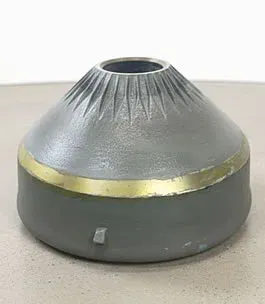
Cone crusher lock nut and clamping components manufactured by ATF

Precision-machined lock nut secures the mantle to the head assembly with correct clamping force

OEM Compatibility

ATF manufactures lock nuts and adjustment components for all major cone crusher brands with model-specific thread specifications.

Metso

  • HP Series (HP100-HP800)
  • GP Series (GP100-GP550)
  • Nordberg Omnicone

Sandvik

  • CH Series (CH420-CH895)
  • CS Series
  • H-Series Hydrocone

Terex / Cedarapids

  • TC Series
  • Kodiak Series

Telsmith

  • T-Series
  • H-Series

Symons

  • Standard (2'-7')
  • Shorthead (2'-7')

Trio / Weir

  • TC Series
  • TP Series

Need Replacement Lock Nuts?

Send your crusher model for a quote with correct thread specifications and materials.

Request a Quote

Material Specifications for Lock Nuts

Lock nuts and adjustment rings are manufactured from heat-treated alloy steel for thread strength and dimensional stability under loading. Surface treatments available for corrosion and galling resistance.

AISI 4140 Alloy Steel

Dureza:28-34 HRC
Aplicação:Standard lock nuts for most cone crushers
Notas:Good balance of strength and machinability

AISI 4340 Alloy Steel

Dureza:32-38 HRC
Aplicação:Heavy-duty applications, large crushers
Notas:Higher strength for demanding service

Cast Steel (with machined threads)

Dureza:250-300 HB
Aplicação:OEM replacement for cast designs
Notas:Matches original equipment construction

Note: Thread form (Acme, Buttress, or proprietary) varies by crusher manufacturer. Specify crusher model for correct thread specification.

Perguntas frequentes

Lock Nuts Perguntas frequentes

Encontre respostas para perguntas comuns sobre lock nuts materiais, seleção, manutenção e pedidos. Não encontrou o que procura?

Contatar nossa equipe
How do I know if lock nut threads are worn?
Several operational symptoms indicate lock nut thread wear that warrants inspection and potential replacement. Difficulty achieving consistent torque when tightening the lock nut suggests thread surfaces have galled or deformed, preventing smooth engagement. If the CSS does not hold its setting during operation and gradually drifts open, the threads may have worn to the point where they cannot maintain adequate axial clamping force against the reaction forces from crushing. Visible thread damage including galling marks (metal transfer between mating surfaces), thread crest deformation, or surface pitting from corrosion all reduce the effective thread engagement area and load-carrying capacity. Excessive axial play in the adjustment mechanism when the lock nut is fully tightened indicates cumulative thread wear has increased the backlash beyond acceptable limits. For quantitative assessment, use thread gauges (go/no-go or profile gauges) to verify thread dimensions against the OEM specification. Measure thread pitch diameter, which is the primary indicator of wear for load-carrying threads. If pitch diameter exceeds the OEM wear limit or if more than 25% of the thread engagement area shows visible damage, replace the lock nut.
Can lock nut threads be repaired?
Limited thread repair is technically possible through re-machining or thread re-cutting, but this approach has significant limitations for safety-critical liner retention applications. Re-machining worn threads to a clean profile reduces the pitch diameter, decreasing both the thread engagement depth and the load-carrying cross-section. Depending on the extent of wear, re-machined threads may retain only 60-80% of the original load capacity, which may be insufficient for the clamping forces required during crushing. Thread repair by weld buildup followed by re-machining is also possible but introduces heat-affected zones that alter the base material properties, and achieving correct thread geometry on a large-diameter Acme or Buttress thread with weld buildup requires specialized CNC equipment and skilled operators. For the mating bowl thread, which is part of the expensive bowl assembly, repair is often justified because bowl replacement is extremely costly. For the lock nut itself, which is a more affordable component, replacement with a new precision-machined lock nut from ATF is typically more cost-effective and provides guaranteed performance matching the OEM specification.
What causes lock nut thread damage?
Lock nut thread damage in cone crushers results from several preventable causes. Operating with insufficient or contaminated lubrication is the most common factor, as Acme and Buttress threads under high axial load require adequate anti-seize compound or thread lubricant to prevent metal-to-metal contact between the mating surfaces. Without lubrication, the contact pressure between thread flanks can exceed the yield strength of the steel, causing galling (adhesive transfer of material between surfaces). Forcing the adjustment mechanism when threads are already galled dramatically worsens the damage. Cross-threading during assembly—particularly on large-diameter threads where alignment is difficult—creates local deformation that propagates with each subsequent tightening cycle. Material ingress from dust, crushed fines, and moisture entering the thread area creates an abrasive paste that accelerates thread wear during adjustment. Corrosion from moisture and acidic material dust attacks thread surfaces and creates pitting that concentrates contact stress. To prevent thread damage, apply recommended anti-seize compound before each adjustment, keep thread areas clean and protected from material ingress, never force a binding adjustment mechanism, and inspect threads at each liner change.
Should I replace the lock nut with every liner change?
Routine replacement at every liner change is not required if threads are in good condition, but thorough inspection with each liner change is mandatory. Using thread gauges and visual examination, verify that the pitch diameter is within the OEM specification, thread flanks show no galling or deformation, and thread surface finish is free of significant pitting or corrosion. Clean and re-lubricate threads with recommended anti-seize compound at every liner change regardless of thread condition. Replace the lock nut if adjustment becomes noticeably difficult or inconsistent, if CSS will not hold setting during operation, if thread gauge measurements indicate pitch diameter has exceeded the wear limit, or if more than 25% of visible thread surface shows damage from galling or corrosion. For operations running highly abrasive material or in corrosive environments (salt water, acidic rock types), thread wear accelerates and more frequent replacement may be needed. Many operators establish a fixed replacement interval of every 3-4 liner changes as preventive maintenance, which represents a modest cost relative to the operational disruptions caused by a degraded adjustment mechanism.

Conteúdo técnico revisado pela equipe de engenharia da ATF | Especificações metalúrgicas verificadas conforme normas ASTM/ISO

Order Precision Lock Nuts

Provide your crusher model for lock nut quotation with correct thread specifications.

Contact ATF Engineering
100%
Thread Accuracy
OEM
Specifications
ISO
Quality Certified

Solicite um Orçamento Gratuito Hoje

Nossa equipe de engenharia responde em 24 horas com especificações detalhadas, recomendações de materiais e preços competitivos.

Resposta em 24 Horas Ajuste OEM Garantido Envio Mundial