
Soquete | Peças para Britador Cônico | ATF

Peças para Britador Cônico

Soquete | Peças para Britador Cônico | ATF

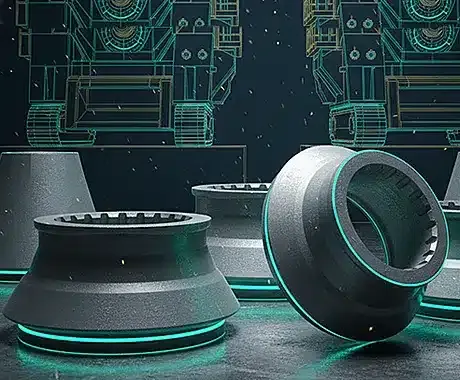
Soquetes e revestimentos para britadores cônicos. Superfícies de apoio mandriladas com precisão para alinhamento correto.

Mantos Revestimentos da Bacia Côncavos

Especificações principais

Liner Alloys
C93200, C95400, C93700 bronze; Babbitt-lined
Liner Hardness
20-170 HB depending on alloy
Radial Clearance
0.20-0.50 mm typical (model-specific)
Seating Geometry
Spherical seat for pivot motion under load
OEM Brands
Metso, Sandvik, Terex, Telsmith, Symons, FLSmidth
Standards
ASTM B505 (bronze), ASTM B23 (babbitt)
Oversize Options
Custom OD liners for worn socket bores
Sockets

Socket Assemblies: Main Shaft Support and Alignment

The socket (also called the bottom shell bushing housing or mainframe bearing seat) supports the lower end of the main shaft and maintains correct geometric alignment with the eccentric assembly above. This component works with precision-fitted bronze or babbitt liners conforming to ASTM B505 or ASTM B23 to create a spherical bearing surface that allows the main shaft to pivot during its gyratory motion while absorbing the full vertical component of crushing forces, which can exceed 300-800 kN in large cone crushers. The spherical seat geometry ensures that load is distributed evenly across the bearing surface rather than concentrated on edge contacts, which is critical for preventing localized overloading and premature liner failure. Socket liners are manufactured from centrifugally cast bronze alloys (C93200 leaded tin bronze, C95400 aluminum bronze, or C93700 high-lead bronze) selected based on the specific loading and lubrication conditions of each crusher model.

Socket geometry is critical for cone crusher performance and component longevity throughout the machine. An out-of-round or worn socket bore causes main shaft misalignment that propagates upward through the entire crusher, creating asymmetric loading on eccentric bushings, uneven mantle-to-concave clearances, and potential metal-to-metal contact between crushing surfaces. Even modest socket bore wear of 0.3-0.5 mm beyond the OEM clearance specification can generate measurable vibration increases and accelerate wear on bushings, liners, and seals. ATF supplies complete socket assemblies with pre-fitted liners, individual socket liners machined to standard OEM bore dimensions, and custom oversized outer diameter liners for worn socket bores. The oversized liner option allows operators to restore correct main shaft alignment without replacing the entire socket housing—the worn bore is machined to a controlled oversize dimension, and a new liner with matching OD is pressed in to restore the original bearing geometry at a fraction of the cost of housing replacement.
Precision Machined
OEM Geometry
Bronze Lined
Cone crusher socket liner in bronze alloy manufactured by ATF

Bronze socket liner provides low-friction bearing surface for the main shaft eccentric motion

Key Features of ATF Socket Components

Precision Bore Accuracy

Socket bores machined to exact OEM specifications for correct bushing fit and main shaft alignment.

Premium Bronze Liners

Socket liners cast from selected bronze alloys with oil grooves machined to OEM patterns.

Spherical Seating

Spherical seat geometry allows the main shaft to pivot while maintaining proper load distribution.

Complete Assemblies

Complete socket assemblies available including housing, liners, seals, and fasteners.

Oversize Liners

Oversized OD liners available for worn socket bores—avoids housing replacement.

Field Machining Support

Technical support available for field machining of socket bores to accept oversized liners.

Socket Liner Material Options

Socket liners are manufactured from bronze alloys selected for the bearing loads and lubrication conditions in cone crusher applications.

C93200 Leaded Tin Bronze

Dureza:60-70 HB
Aplicação:Standard socket liners, oil-lubricated
Notas:Good load capacity and lubricity

C95400 Aluminum Bronze

Dureza:150-170 HB
Aplicação:Heavy-duty applications, high-load crushers
Notas:Higher strength and wear resistance

C93700 High-Lead Bronze

Dureza:55-65 HB
Aplicação:Applications with intermittent lubrication
Notas:Better boundary lubrication properties

Babbitt-Lined Bronze

Dureza:20-30 HB (babbitt surface)
Aplicação:OEM replacement where babbitt specified
Notas:Conformable, forgiving of minor misalignment

Note: Socket liner material and geometry must match OEM specifications. Contact ATF with crusher model for correct selection.

Need Socket Liners or Assemblies?

Send your crusher model for a quote on socket components with correct specifications.

Request a Quote

OEM Compatibility

ATF manufactures socket assemblies and liners for all major cone crusher brands with correct geometry and bearing specifications.

Metso

  • HP Series (HP100-HP800)
  • GP Series (GP100-GP550)

Sandvik

  • CH Series (CH420-CH895)
  • CS Series
  • H-Series Hydrocone

Terex / Cedarapids

  • TC Series
  • Kodiak Series

Telsmith

  • T-Series (T200-T900)
  • H-Series

Symons

  • Standard (2'-7')
  • Shorthead (2'-7')

FLSmidth

  • Raptor Series
Perguntas frequentes

Sockets Perguntas frequentes

Encontre respostas para perguntas comuns sobre sockets materiais, seleção, manutenção e pedidos. Não encontrou o que procura?

Contatar nossa equipe
What causes socket liner wear?
Socket liner wear is a normal consequence of the continuous pivoting motion of the main shaft under heavy crushing loads, but the rate of wear is controlled by several operational factors that can be managed to extend liner service life. Insufficient lubrication—caused by low oil level, pump degradation, clogged oil passages, or wrong oil viscosity grade for the operating temperature—allows boundary contact between the shaft and liner surface, dramatically accelerating wear. Contaminated oil containing abrasive particles from dust seal leakage, water from seal failures or condensation, or metal debris from other worn components creates an abrasive slurry in the bearing clearance. Operating with worn eccentric bushings causes shaft misalignment that creates concentrated loading on one sector of the socket liner rather than distributing load evenly across the spherical surface. Overloading the crusher beyond design capacity increases unit bearing pressure beyond the oil film support capacity. Regular oil analysis at 250-500 hour intervals monitoring particle count, water content, viscosity, and spectrometric metals (copper, tin, lead, and aluminum for bronze liner wear detection) provides early warning of abnormal wear conditions and helps optimize lubrication maintenance practices.
How do I know if socket liners need replacement?
Several operational symptoms indicate that socket liners have worn beyond acceptable limits and require replacement. Excessive main shaft movement manifested as visible wobble at the mantle during operation (observed from a safe distance) confirms that radial clearances have exceeded the OEM specification, which is typically 0.20-0.50 mm for new installations depending on shaft diameter and model. Unusual metallic noise emanating from the socket area during crusher rotation indicates intermittent metal-to-metal contact between the shaft and liner. Elevated oil return temperature beyond the normal operating range suggests increased friction from worn bearing surfaces with inadequate oil film. Bronze particles visible in oil samples or detected through spectrometric oil analysis (elevated Cu, Sn, Pb, or Al concentrations) provide quantitative confirmation of liner wear rate. The definitive assessment requires measuring shaft-to-liner clearance using calibrated instruments during a planned maintenance stop. Compare the measured clearance to the OEM maximum allowable clearance specification—if exceeded, immediate liner replacement is required to prevent main shaft damage.
Can socket housings be repaired if worn?
Yes, worn socket bores can frequently be repaired by machining to a controlled oversize dimension and installing new liners with correspondingly oversized outer diameters, which is substantially more cost-effective than replacing the entire socket housing. The repair process involves measuring the existing bore to determine the extent and pattern of wear, setting up a portable boring bar or shipping the housing to a machine shop, machining the bore to a clean round dimension (typically 1-3 mm oversize depending on wear severity), and pressing in a new bronze liner with the matching OD and standard ID. The machined bore must be concentric with the original center axis to within 0.05 mm TIR, round to within 0.025 mm, and finished to Ra 1.6 micrometers or better for proper press-fit and heat transfer. For spherical seat sockets, the spherical profile must be maintained during machining to preserve the self-aligning function. ATF provides technical support for socket bore machining including oversize bore specifications, recommended machining parameters, and custom-manufactured oversized liners matched to the repaired bore dimensions.
What clearances should socket liners have?
Socket liner clearances are precisely specified by the OEM for each crusher model and must be verified against these specifications rather than generic guidelines. Typical radial clearances for socket liners range from 0.20-0.50 mm depending on shaft diameter, spherical seat geometry, and lubrication system design. The clearance requirements for socket liners are generally slightly larger than eccentric bushing clearances because the pivoting motion creates different hydrodynamic conditions than the rotating motion in the eccentric. Too little clearance restricts oil flow, prevents the shaft from pivoting freely, creates localized heat buildup from fluid shear, and can cause seizure during startup when thermal expansion closes the gap. Too much clearance allows excessive shaft movement that transfers as vibration and uneven loading to the mantle and concave, creating asymmetric wear patterns. Measure socket liner clearance using calibrated bore gauges for the liner ID and micrometers for the shaft OD at multiple axial positions to detect taper wear. Compare measurements to the OEM new and maximum wear specifications, and plan replacement when clearance approaches the maximum allowable limit rather than waiting until it is exceeded.

Conteúdo técnico revisado pela equipe de engenharia da ATF | Especificações metalúrgicas verificadas conforme normas ASTM/ISO

Order Socket Assemblies and Liners

Provide your crusher model for quotation on socket components with correct specifications.

Contact ATF Engineering
OEM
Geometry
ISO
Quality Certified
100%
Fit Guarantee

Solicite um Orçamento Gratuito Hoje

Nossa equipe de engenharia responde em 24 horas com especificações detalhadas, recomendações de materiais e preços competitivos.

Resposta em 24 Horas Ajuste OEM Garantido Envio Mundial