

Peças para Britador de Martelos
Peças para Britador de Martelos | Martelos, Grelhas e Reposição | ATF
Peças para britadores de martelos: martelos, barras de grelha, placas de quebra e componentes de rotor. Opções em manganês, martensítico e alto cromo.
Hammers, Grates & Rotor Components for Hammer Crushers and Shredders
Hammer crushers, hammer mills and industrial shredders use rotating hammers to deliver high-energy impacts to feed material at tip speeds of 25–50 m/s, fracturing material through direct impact and throwing it against stationary breaker plates for secondary size reduction. These machines handle everything from limestone and coal to demolition waste, recycling feedstock and hot clinker — each application presenting a different balance of impact loading, abrasion severity and tramp metal risk that determines optimal hammer material selection.
ATF manufactures hammers, grate bars, breaker plates and rotor components in application-matched materials: austenitic manganese steel (Mn14Cr2, Mn18Cr2) for high-impact and tramp metal tolerance, martensitic steel (450–550 BHN) for balanced impact-abrasion duty, high-chrome white iron (60–64 HRC) for clean abrasive feeds, and bimetallic designs combining tough bodies with hard wear faces. All hammer sets are precision weight-matched within 1–2% to prevent rotor imbalance that accelerates bearing and housing wear.
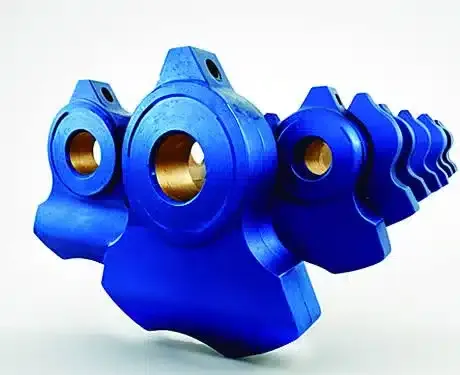
ATF hammer crusher components — hammers in manganese, martensitic and high-chrome alloys, weight-matched and machined to OEM specifications for hammer crushers, hammer mills and industrial shredders.
How Hammer Crushers and Shredders Work
Understanding the impact mechanics, material flow path and wear patterns inside hammer crushers explains why material selection must balance impact toughness against abrasion resistance — and why the optimal alloy differs between crushing limestone, shredding recycling feedstock, and processing hot clinker.
High-Velocity Impact
Feed material enters the crusher and is struck by hammers spinning at tip speeds of 25–50 m/s. Each impact transfers kinetic energy proportional to the hammer mass and the square of the velocity — making both hammer weight and rotor speed critical parameters. The hammer face angle determines whether material is fractured by direct compression, sheared, or deflected toward the breaker plates. Hammers experience concentrated wear at the leading edge impact zone and progressive mass loss from abrasion across the striking face.
Secondary Crushing & Size Control
Material thrown by the hammers impacts stationary breaker plates (anvils) on the crusher housing wall, providing secondary size reduction. In reversible crushers, breaker plates on both sides of the chamber allow the rotor direction to be reversed periodically, equalising wear between the two sets of plates. The gap between hammer tips and breaker plates controls the degree of size reduction — smaller gaps produce finer product but increase wear on both hammers and plates. Grate bars at the discharge control maximum product size.
Product Discharge & Recirculation
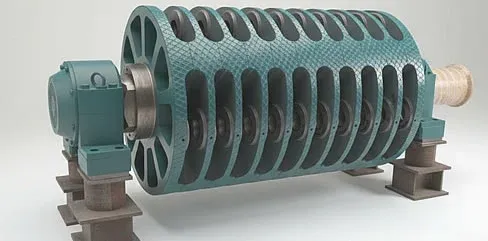
Correctly sized product passes through the grate bars at the crusher base, while oversize material is retained in the crushing chamber for re-impact by subsequent hammer passes. High recirculation rates (from worn hammers or worn grate bars) increase energy consumption and temperature, accelerating wear on all chamber components. In hammer mills without grate bars, an air classifier separates the product by particle size. The entire rotor assembly — hammers, pins, discs and shaft — must remain balanced as hammers wear to prevent destructive vibration.
Hammer Crusher & Shredder Components
ATF manufactures the complete range of hammer crusher and shredder wear components — from weight-matched hammer sets to grate bars, breaker plates and rotor assemblies. Each component is manufactured in application-specific alloys with full dimensional verification.
Crusher Hammers
The primary impact elements — hammers are mounted on rotor pins and deliver high-energy impacts to feed material at tip speeds of 25–50 m/s. Available in manganese steel (Mn14Cr2, Mn18Cr2) for high-impact applications, martensitic steel (450–550 BHN) for balanced duty, and high-chrome white iron (60–64 HRC) for maximum abrasion resistance with clean feeds. Weight-matched sets from 10 kg to 500 kg per hammer.
Grate Bars & Discharge Screens
Product sizing components at the crusher discharge — grate bars and screens determine maximum product size by retaining oversize material for re-crushing while allowing correctly sized particles to pass through. Aperture sizes from 10–150 mm in wear-resistant alloys matched to target product gradation. Available in manganese steel, martensitic alloys, and high-chrome iron depending on abrasion severity.
.CG7__AJy_28SaAL.webp)
Breaker Plates, Rotor Discs & Other Parts
Breaker plates (anvils), rotor discs, shaft components, housing liners and wear plates that complete the hammer crusher assembly. Breaker plates in manganese steel provide the stationary impact surface against which hammers throw material for secondary size reduction. Rotor discs and spacers maintain hammer positioning and must be precision-machined for correct clearances.
Hammer Material Selection Guide
Hammer material selection is fundamentally a trade-off between impact toughness and abrasion resistance. The key question: does your application require a hammer that absorbs impact energy without breaking (manganese), or one that resists abrasive wear without work-hardening (martensitic/high-chrome)?
Mn14Cr2 Manganese Steel
ASTM A128 Grade B-2 — 14% Mn, 2% Cr
High-impact hammer crusher applications — demolition recycling, clinker crushing, hard rock processing and any application where tramp metal (excavator teeth, drill steel, rebar) may enter the feed
3–6 months (high-impact service)
Limitation: Lower initial hardness means higher early wear rate in purely abrasive applications without significant impact — not optimal for clean, fine feeds where martensitic or high-chrome would provide longer life
Mn18Cr2 Manganese Steel
ASTM A128 Grade B-3 — 18% Mn, 2% Cr
Maximum toughness for the most severe impact conditions — primary hammer crushers processing hard rock, heavy demolition waste with embedded steel, or any application where hammer breakage is a recurring problem with lower-Mn grades
4–8 months (severe impact service)
Limitation: Higher cost than Mn14 with only marginal improvement in abrasion resistance. Use where the higher work-hardening ceiling (500+ HB vs 400+ HB) justifies the premium over Mn14Cr2
Martensitic Steel (Cr-Mo)
Proprietary Cr-Mo formulations — 450–550 BHN
Balanced applications with moderate impact and abrasion — limestone, dolomite, coal, aggregate production where tramp metal is controlled and impact severity is moderate
4–10 months (balanced service)
Limitation: Insufficient toughness for heavy tramp metal exposure — will crack or break where manganese steel would absorb the impact. Not suitable for demolition recycling or unscreened feed
High-Chrome White Iron
ASTM A532 Class III — 27% Cr, 60–64 HRC
Clean, highly abrasive feeds with low impact — coal crushing, glass cullet, mineral sands, chemical minerals where the feed is pre-screened to remove tramp metal and oversize
6–18 months (abrasive, low-impact service)
Limitation: Brittle under impact loading — will fracture from tramp metal or large oversize lumps. Not recommended for any application with unscreened feed or demolition waste
Bimetallic (Mn Body + Cr-Mo Face)
Manganese steel body + martensitic or high-chrome wear face
Applications requiring both impact toughness and abrasion resistance — the tough Mn body absorbs impact energy while the hard wear face resists abrasion at the striking surface
6–12 months (combined impact/abrasion)
Limitation: Higher cost than monolithic designs. Bond integrity must withstand continuous impact loading — inferior manufacturing can lead to delamination at the bimetallic interface
Hammer Material Decision Framework
Tramp metal in feed? → Manganese steel (Mn14Cr2 or Mn18Cr2) — only ductile alloys survive tramp metal impact without fracturing
Heavy impact, no tramp metal? → Mn14Cr2 for standard duty; Mn18Cr2 where hammers are breaking in Mn14
Moderate impact + abrasion? → Martensitic steel (450–550 BHN) — hard as-delivered, good all-around performance
Clean, abrasive feed, low impact? → High-chrome white iron (60–64 HRC) — maximum abrasion resistance for screened feeds
Need both toughness and hardness? → Bimetallic (Mn body + Cr-Mo face) for combined impact-abrasion applications
Send ATF your crusher model, feed material, throughput and current hammer performance data for a specific material recommendation.
Compatible Crusher & Shredder Brands
ATF manufactures replacement hammers, grate bars and wear components for all major hammer crusher, hammer mill and industrial shredder brands. Parts are manufactured to OEM specifications with guaranteed dimensional fit and weight matching.
Williams Patent Crusher
Meteor Hammer Mill, Impact Dryer Mill, Swing Hammer Crushers, Ring Granulators
Complete hammer and grate sets for all Williams models
Pennsylvania Crusher (TerraSource)
Reversible Hammer Crushers, Non-Reversible, Ring Granulators, Cage Mills
Pennsylvania Crusher / TerraSource Global replacement parts
FLSmidth
EV Hammer Crusher, Impact Hammer Mill, Clinker Hammer Crushers
Including legacy Fuller and FLS hammer crusher designs
Hazemag
HPI Primary Impactors, APS Secondary Crushers, SAP Hammer Crushers
Hazemag & EPR — impact and hammer crusher technology
Stedman Machine
Mega-Slam, Grand-Slam, Aurora, Cage Mill, Hammer Mills
Stedman impact and hammer mill replacement components
Others
Jeffrey Rader, American Pulverizer, Prater, Schutte-Buffalo, FEECO, Chinese-manufactured crushers
Contact ATF with crusher model and hammer dimensions for compatibility confirmation
Don't see your crusher or shredder? ATF manufactures replacement components from OEM drawings or reverse-engineered from samples for any hammer crusher, hammer mill or industrial shredder. Send your machine model and hammer dimensions for fit confirmation.
Verify Your CrusherNeed Hammer Crusher or Shredder Parts?
Send your crusher model, current hammer dimensions and feed material details. ATF will recommend the optimal alloy, provide weight-matched sets and deliver timing aligned to your maintenance schedule.
Hammer Crusher Maintenance Best Practices
Systematic hammer management — monitoring wear, tracking weights, rotating reversible hammers and maintaining rotor balance — is the single most impactful maintenance practice for hammer crusher reliability and cost control.
Every Shift
- Monitor crusher motor current draw — rising current at constant feed rate indicates worn hammers, worn grates, or excessive fines recirculation
- Check product gradation visually — oversize material indicates worn hammers, damaged grate bars or excessive hammer-to-grate clearance
- Listen for abnormal impact noise — irregular heavy impacts suggest broken hammers, loose breaker plates, or tramp metal in the feed
- Monitor bearing temperatures and vibration — rising values indicate rotor imbalance from uneven hammer wear
Weekly
- Inspect hammer wear through crusher inspection doors — measure remaining face thickness at the leading edge impact zone
- Check grate bar condition — worn, bent or broken bars allow oversize product and reduce crushing efficiency
- Inspect breaker plates for wear, cracking or bolt loosening — damaged plates reduce secondary crushing effectiveness
- Verify hammer-to-grate and hammer-to-breaker plate clearances are within specification
Monthly
- Rotate reversible hammers when leading face wear reaches 25–30% of original profile — exposes the unworn trailing face
- Weigh all hammers individually — record weights and identify sets approaching replacement threshold (60–70% mass loss)
- Ensure opposing hammers remain matched within 1–2% of weight — reposition or replace mismatched pairs
- Inspect housing liners, side plates and rotor disc condition — replace any showing excessive wear or cracking
Planned Shutdown
- Replace complete hammer sets as weight-matched assemblies — stagger replacement timing across machines if possible
- Replace grate bars and discharge screens that have reached minimum bar thickness or maximum aperture size
- Inspect and replace breaker plates — particularly at high-velocity impact zones where wear concentrates
- Check rotor disc condition, keyway wear, shaft run-out and overall rotor balance
- Inspect mounting pin holes in hammers and rotor — replace pins showing wear and ream oversized holes if within specification
- Document all hammer weights, wear rates and positions for trend analysis — optimise material selection and rotation intervals
Hammer Material Selection by Application
| Application | Best Material | Typical Life | Key Factor |
|---|---|---|---|
| Recycling / Shredding | Mn18Cr2 / Bimetallic | 2–6 months | Tramp metal tolerance |
| Limestone / Aggregate | Martensitic (450–550 BHN) | 4–10 months | Balanced impact/abrasion |
| Coal Crushing | High-Chrome (60–64 HRC) | 6–18 months | Clean, abrasive feed |
| Hot Clinker | H13 / High-Temp Cr-Mo | 6–12 months | Hot hardness retention |
| Demolition Waste | Mn14Cr2 / Mn18Cr2 | 3–6 months | Heavy tramp metal |
Hammer life estimates assume regular rotation of reversible hammers. Actual life depends on feed abrasiveness, moisture content, rotor speed and crusher capacity utilisation.
Common Hammer Crusher Problems & Solutions
Hammer crusher issues — from breakage and rapid wear to vibration and product quality problems — often trace back to material selection, maintenance practices or operating conditions. Identifying the root cause enables targeted corrective action.
Hammers Breaking Instead of Wearing Gradually
Probable Causes
- Incorrect material grade for the application — using brittle high-chrome (60+ HRC) in high-impact or tramp metal service where manganese is required
- Tramp metal entering the feed — excavator teeth, drill steel, rebar or other metallic debris delivering single-event overload
- Excessive rotor speed generating impact forces beyond the hammer alloy's tensile strength
- Casting defects (porosity, inclusions, improper heat treatment) creating stress concentration points that initiate fracture
Corrective Actions
- Collect broken hammer pieces for metallurgical examination — determine if failure is material-related or overload-related
- Install tramp metal detection and removal equipment (magnets, metal detectors) upstream of the crusher
- Review material selection — switch to manganese steel (Mn14Cr2 or Mn18Cr2) if impact or tramp metal is the root cause
- Specify NDT (ultrasonic or magnetic particle) on replacement hammer castings to reject parts with internal defects
Rapid Hammer Wear (Much Shorter Than Expected Life)
Probable Causes
- Feed material more abrasive than anticipated — high silica content, angular particles or fine abrasive dust accelerating wear
- Operating above design rotor speed — higher tip speed increases both impact energy and abrasive wear rate
- Incorrect hammer material — using manganese in purely abrasive service where martensitic or high-chrome would last longer
- Hammers not being rotated — wearing only the leading face wastes 50% of the available hammer material
Corrective Actions
- Verify feed material characteristics — request abrasion index testing if not already available
- Check rotor speed against OEM specification — reduce speed if operating above design parameters
- Re-evaluate material selection: high-chrome for clean abrasive feeds, martensitic for balanced duty, Mn for high impact
- Implement regular hammer rotation schedule — rotate reversible hammers when leading face reaches 25–30% wear
Excessive Vibration
Probable Causes
- Hammer weight imbalance — uneven wear between opposing hammers creating centrifugal force imbalance
- Broken or missing hammer — severe mass imbalance from a single missing hammer position
- Worn rotor disc keyways or loose hammer pins — hammers not held in correct radial position
- Foundation bolt loosening from cumulative vibration — loss of rigid crusher mounting
Corrective Actions
- Check for broken or missing hammers immediately — a single missing hammer creates severe imbalance
- Weigh all hammers and verify opposing pairs are matched within 1–2% — reposition or replace mismatched sets
- Inspect rotor disc keyways and hammer pin holes — machine or replace components with excessive wear
- Check and re-torque foundation bolts — verify crusher alignment on its mounting
Product Oversize or Poor Gradation
Probable Causes
- Worn hammers with insufficient remaining face area — reduced impact energy transfer to feed material
- Worn or damaged grate bars with enlarged apertures — oversize material passing through without adequate crushing
- Excessive hammer-to-grate or hammer-to-breaker plate clearance — material passing through the gap without being struck
- Feed rate too high relative to crusher capacity — insufficient residence time for adequate size reduction
Corrective Actions
- Measure remaining hammer face area — replace hammers when face thickness falls below minimum for effective crushing
- Inspect and replace grate bars with enlarged apertures — verify bar spacing matches target product specification
- Adjust hammer-to-grate and hammer-to-breaker plate clearances to OEM specification
- Review feed rate versus crusher design capacity — reduce feed rate or consider a larger crusher for the duty
Recurring Grate Bar Failure
Probable Causes
- Impact from large oversize material or tramp metal bending or breaking grate bars
- Incorrect grate material for the abrasion severity — mild steel bars in highly abrasive service
- Inadequate bar support allowing flexing under impact load — bars fatigue and crack at support points
- Thermal stress from hot material (clinker service) causing thermal fatigue in standard steel bars
Corrective Actions
- Upgrade grate bar material — martensitic steel for moderate duty, high-chrome for severe abrasion
- Install tramp metal protection upstream to prevent impact damage to grate bars
- Review grate bar support arrangement — ensure bars are properly seated and supported to prevent flexing
- For hot material service, specify heat-resistant alloys with thermal expansion allowances
Frequently Asked Questions
Answers to common questions about hammer crusher and shredder parts — materials, weight matching, rotation schedules, troubleshooting and ordering. Can't find what you're looking for?
Contact Our TeamWhat determines the best hammer material for my crusher?
How often should hammers be rotated or replaced?
Why is hammer weight matching critical?
Can you supply hammers for recycling shredders?
What causes hammers to break instead of wearing gradually?
Do you manufacture grate bars and screens as well as hammers?
What information do you need to quote hammer crusher parts?
What is the typical lead time for hammer crusher parts?
Get a Quote for Hammer Crusher Parts
Weight-matched hammer sets, grate bars and breaker plates in application-specific alloys. ATF provides material recommendations, OEM-fit guarantee and competitive pricing for all major hammer crusher and shredder brands.
Contact ATF EngineeringSolicite um Orçamento Gratuito Hoje
Nossa equipe de engenharia responde em 24 horas com especificações detalhadas, recomendações de materiais e preços competitivos.