

Peças para Britador de Mandíbulas
Peças para Britador de Mandíbulas | Placas e Reposição | ATF
Peças para britadores de mandíbulas: placas fixa e oscilante, placas de bochecha, articulações e reposição em manganês Mn14-Mn22. Envie modelo e câmara.
Complete Wear Part Solutions for Jaw Crushers
Jaw crushers reduce material through cyclic compression between a fixed jaw plate and a moving (swing) jaw plate. An eccentric shaft drives the pitman in a reciprocating motion, alternately compressing material against the fixed jaw and releasing it to fall toward the discharge. This simple, robust mechanism handles the hardest feed materials — making jaw crushers the standard primary crusher for mining, quarrying and demolition operations worldwide.
Every component in a jaw crusher — from the jaw plates that deliver the crushing action to the toggle plate that protects the frame — works as an integrated system. Jaw plate profile, manganese grade, CSS setting and toggle specification all interact to determine throughput, product quality and operating cost. ATF engineers and manufactures the complete range of jaw crusher wear parts and structural spares to OEM specifications, with manganese grades and tooth profiles optimised for your specific feed conditions.
ATF jaw plates ready for dispatch — fixed and swing plates in Mn13–Mn22 manganese steel, tooth profiles matched to OEM chamber geometry.
Jaw Crushing Mechanism
Understanding how each component contributes to the compression crushing cycle explains why jaw plate profile selection, CSS control and toggle plate specification directly affect product quality, throughput and equipment protection.
Feed Entry
Material enters the jaw crusher from the top through the feed opening (gape). For efficient crushing, feed material should be at least 80% of the gape width. Undersized feed passes through without being crushed, wasting energy. A grizzly feeder or scalping screen upstream removes fines and ensures the crusher receives correctly sized material.
Compression Crushing
The eccentric shaft rotates, driving the pitman and swing jaw forward toward the fixed jaw. Material trapped between the two jaw plates is compressed and fractured. The jaw plate tooth profile grips the rock surface, preventing it from sliding upward out of the chamber. Each revolution of the eccentric produces one complete compression-release cycle — typically 250–350 cycles per minute.
Product Discharge
When the swing jaw moves away from the fixed jaw (the release stroke), crushed material falls by gravity toward the discharge opening. The closed-side setting (CSS) — the minimum gap at the bottom of the chamber — determines the maximum product particle size. Material that hasn't been reduced sufficiently is re-crushed in subsequent compression cycles. Typical reduction ratios range from 4:1 to 6:1.
Jaw Crusher Wear Parts & Structural Spares
A jaw crusher requires four categories of wear and structural parts. Each component page provides detailed material options, OEM compatibility tables and application-specific guidance.
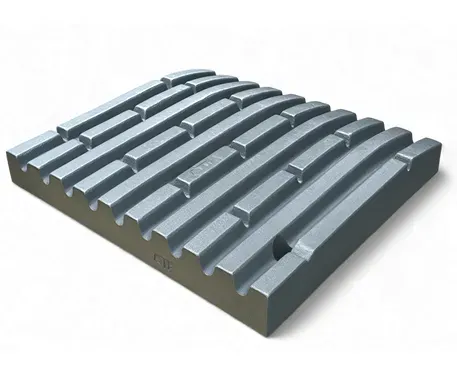
Jaw Plates (Fixed & Swing)
The primary wear parts in every jaw crusher. The fixed jaw plate is bolted to the stationary frame; the swing (movable) jaw plate is mounted on the pitman. Together they form the crushing chamber. Tooth profile, manganese grade and plate thickness determine product gradation, throughput and wear cost per ton.
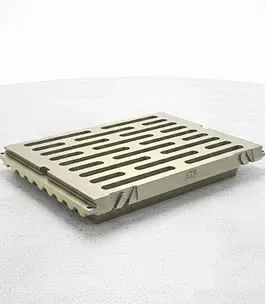
Cheek Plates & Side Liners
Protect the jaw crusher frame side walls from abrasive material contact. Cheek plates absorb wear from material that escapes the primary crushing zone laterally. Worn cheek plates expose the cast frame to irreversible erosion damage that requires costly weld repair.
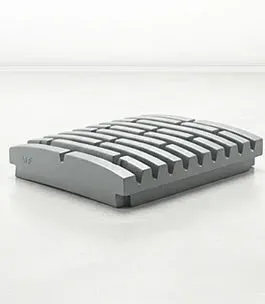
Toggle Plates
The mechanical fuse of a jaw crusher. Toggle plates are engineered to fracture at a calibrated load threshold, protecting the crusher frame, pitman and bearings from catastrophic damage caused by uncrushable tramp material. Never substitute with a stronger toggle — it defeats the safety function.
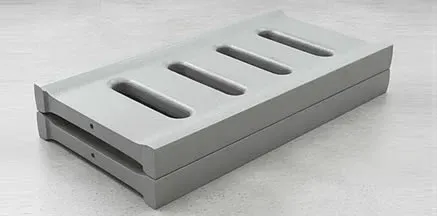
Additional Spares
Wedge blocks, toggle seats, bearing housings, flywheels, pitman assemblies and eccentric shafts. These structural and drive components maintain crusher geometry and transmit the forces that drive the crushing action. Worn or damaged spares compromise jaw plate alignment and crushing efficiency.
Manganese Grade Selection for Jaw Crusher Plates
Manganese grade is the single most important decision affecting jaw plate wear life and cost per ton crushed. The correct grade depends on the impact energy in your application — determined by feed material hardness, feed size, CSS and crusher speed. Using a higher grade than needed wastes money. Using too low a grade results in rapid, expensive wear.
Mn13Cr2 Manganese Steel
Mn13Cr2 (standard)
General-purpose primary and secondary jaw crushing — limestone, gravel, recycled concrete
Baseline
Limitation: May not work-harden sufficiently in light-duty applications with soft feed material
Mn18Cr2 Manganese Steel
Mn18Cr2 (high-manganese)
Hard rock primary crushing — granite, basalt, quartzite, gneiss with high compressive strength
1.2–1.5× Mn13 in hard rock
Limitation: Higher cost than Mn13 — only justified where feed hardness generates sufficient impact to activate work-hardening
Mn22Cr2 Manganese Steel
Mn22Cr2 (ultra-high manganese)
Extreme-duty primary crushing of very hard, abrasive rock at high reduction ratios
1.5–2× Mn13 in extreme-impact applications
Limitation: Premium cost — only economical in high-tonnage operations where extreme impact energy fully activates the manganese
Mn + TiC Composite
Mn14/Mn18 base + TiC inserts (2800 HV)
Abrasive primary and secondary crushing where maximum jaw plate life justifies higher upfront cost
2–3× standard manganese
Limitation: TiC inserts can spall under extreme point-load impact from very large feed — best suited for controlled feed sizes
Quick Selection Framework
Standard primary/secondary crushing (limestone, gravel, concrete)? → Mn13Cr2 — the proven all-round standard
Hard rock primary crushing (granite, basalt, quartzite)? → Mn18Cr2 — higher work-hardening for harder feed
Extreme duty with very hard, abrasive rock? → Mn22Cr2 — maximum toughness and work-hardening capacity
Maximum jaw plate life in abrasive applications? → Mn + TiC composite for 2–3× standard manganese life
Not sure which grade applies? Contact ATF with your crusher model, feed material, feed size and target CSS — we'll recommend the optimal manganese grade and tooth profile.
Compatible Jaw Crusher Brands & Models
ATF manufactures aftermarket jaw plates, cheek plates and structural spares to OEM dimensional and profile specifications. All jaw plates are verified against original profile drawings before production. Dimensional tolerance: length ±2 mm, weight ±2%, bolt holes ±0.5 mm.
Metso
C80, C96, C100, C106, C110, C116, C120, C125, C130, C140, C150, C160, C200
Nordberg C series — most common globally
Sandvik
CJ208, CJ209, CJ211, CJ411, CJ412, CJ612, CJ613, CJ815, QJ241, QJ341, QJ441
Stationary CJ and mobile QJ series
Terex / Cedarapids
JW42, JW55, Jaques JW40, JW55, Pegson XA400, XA750
Including Jaques, Cedarapids and Pegson models
Kleemann
MC 100, MC 110, MC 120, MC 140
Wirtgen Group mobile jaw crushers
Trio / Weir
CT1030, CT1036, CT2036, CT2436, CT3042, CT3254
Trio stationary jaw crushers
FLSmidth
Essa JC2000, JC3000, JC5000, TST Jaw Crushers
FLSmidth and former Essa range
Don't see your crusher model? ATF maintains patterns and profile drawings for 50+ jaw crusher models including discontinued and legacy equipment. Send your crusher nameplate or part number for confirmation.
Verify Your ModelNeed Jaw Crusher Parts Fast?
Stock jaw plates and common wear parts ship within 1–2 weeks. Send your crusher model, tooth profile and part requirements for a same-day quotation.
Jaw Crusher Maintenance Best Practices
Disciplined maintenance extends jaw plate life, prevents unplanned downtime and protects the crusher frame, pitman and bearings from damage caused by worn plates, loose fasteners or neglected toggle plates.
Every Shift
- Visual inspection through access doors — check for loose, cracked or shifted jaw plates
- Listen for abnormal sounds: metallic banging indicates tramp metal, grinding suggests plate contact
- Check toggle plate seating — a dislodged toggle creates uncontrolled jaw movement
Weekly
- Measure closed-side setting (CSS) and compare to target — adjust wedge blocks if product gradation has drifted
- Inspect cheek plates for breakthrough wear approaching the frame wall
- Check jaw plate bolt tension — loose bolts allow plate movement that accelerates wear and cracks castings
Monthly
- Measure jaw plate wear at multiple points (top, centre, bottom) — uneven wear indicates feed distribution or profile issues
- Inspect toggle plate for cracking, deformation or seat wear — replace if any damage is visible
- Check bearing temperatures and lubrication — elevated temperature indicates bearing deterioration
At Jaw Plate Change
- Inspect frame jaw seating surfaces for erosion, cracking or weld build-up that prevents flat plate contact
- Check pitman bore and bearing clearances — replace bearings if worn beyond tolerance
- Verify wedge block and CSS adjustment mechanism operates smoothly through full range
- Inspect flywheel and eccentric shaft for cracks or keyway damage
- Replace all jaw plate bolts — never reuse stretched or corroded fasteners
Jaw Plate Wear Stages & Action Points
| Wear Stage | Tooth Depth | Action | Notes |
|---|---|---|---|
| New | 100% | Re-torque bolts after 8h | Initial seating period |
| Mid-Life | 50–75% | Adjust CSS, monitor wear rate | Consider reversing plates if design allows |
| End-of-Life | 25% | Plan replacement | Flat plates reduce throughput 20–30% |
| Critical | <10% | Replace immediately | Risk of frame damage from plate-through wear |
Some jaw plate designs allow 180° reversal at mid-life to extend total wear life. Check with ATF whether your plate profile supports reversal.
Common Jaw Crusher Problems & Solutions
Recognising wear patterns and operational symptoms early prevents costly damage to the frame, pitman, bearings and toggle assembly. Contact ATF technical support if you need help diagnosing an issue.
Uneven Jaw Plate Wear
Probable Causes
- Off-centre feed — material entering from one side of the feed opening
- Jaw plate not seated flat against the frame — voids behind the plate cause localised flexing
- Incorrect tooth profile for the feed material and size distribution
Corrective Actions
- Centre the feed using chute adjustments or a grizzly feeder — material should enter across the full width
- Remove plates and inspect frame seating surface — repair any erosion with weld build-up and re-machine
- Review tooth profile selection — coarser profiles suit larger feed, finer profiles suit secondary applications
Jaw Plate Cracking or Breakage
Probable Causes
- Tramp metal (loader teeth, drill bits, steel) exceeding toggle plate break threshold
- Jaw plate bolts not torqued correctly — loose plates flex and fatigue-crack under load
- Manganese grade too low for the impact energy — insufficient work-hardening depth
Corrective Actions
- Install or maintain a scalping screen and metal detector ahead of the crusher
- Re-torque all jaw plate bolts to OEM specification — check after initial 8 hours of operation
- Upgrade manganese grade to match actual feed conditions — Mn18 or Mn22 for harder rock
Toggle Plate Breaking Frequently
Probable Causes
- Regular tramp metal events — the toggle is doing its job as a mechanical fuse
- Toggle plate design load is too low for the application (incorrect model)
- Crusher set too tight (CSS below minimum) creating excessive crushing force
Corrective Actions
- Address the root cause: improve feed screening and metal detection upstream
- Verify the correct toggle plate specification for your crusher model and application
- Open CSS to within the manufacturer's recommended range — over-tight CSS multiplies crushing forces
Excessive Vibration or Frame Movement
Probable Causes
- Flywheel imbalance — worn or broken counterweights
- Worn eccentric shaft bearings allowing excessive pitman play
- Foundation bolts loosened — crusher moving relative to its base
Corrective Actions
- Inspect flywheel balance and counterweight condition — replace if damaged
- Check bearing clearances against OEM specification and replace if beyond tolerance
- Re-torque all foundation bolts — inspect concrete base for cracking or erosion
Reduced Throughput or Oversized Product
Probable Causes
- Jaw plates worn past effective profile — tooth pattern too shallow for material engagement
- CSS has opened due to plate wear — product is coarser than specification
- Feed material is too fine for the chamber — jaw crushers are inefficient below minimum feed size
Corrective Actions
- Replace jaw plates when tooth depth is less than 25% of original — flat plates slide material instead of crushing
- Adjust CSS using wedge blocks to compensate for wear — reset to target setting
- Ensure feed size is appropriate — jaw crushers need feed at least 80% of the gape width to operate efficiently
Frequently Asked Questions
Answers to common questions about jaw crusher parts, manganese grade selection, maintenance and ordering. Can't find what you're looking for?
Contact Our TeamWhat is the difference between a fixed jaw plate and a swing jaw plate?
How do I choose the correct manganese grade for jaw plates?
What tooth profile should I use on my jaw plates?
How often should jaw plates be replaced?
Why is the toggle plate called a mechanical fuse?
Are ATF jaw crusher parts compatible with OEM equipment?
What information does ATF need to quote jaw crusher parts?
What is the typical lead time for jaw crusher parts?
Ready to Optimise Your Jaw Crusher Performance?
ATF engineers respond within 24 hours with manganese grade recommendations, tooth profile verification and competitive pricing for your specific crusher and application.
Request a Free QuoteSolicite um Orçamento Gratuito Hoje
Nossa equipe de engenharia responde em 24 horas com especificações detalhadas, recomendações de materiais e preços competitivos.