
Placas de Impacto | Peças para Britador HSI | ATF

Peças para Britador HSI

Placas de Impacto | Peças para Britador HSI | ATF

Placas de impacto para britadores HSI. Opções em aço manganês (Mn14-Mn18) e liga de cromo conforme posição na câmara e condições de abrasão-impacto.

Barras de impacto Insertos cerâmicos Placas de impacto

Especificações principais

Material Grades
Mn14Cr2, Mn18Cr2, High-Chrome Iron, Ceramic MMC
Hardness Range
200-500+ BHN (Mn) / 60-64 HRC (Cr)
Chamber Positions
Primary, Secondary, Tertiary
OEM Brands
Metso, Sandvik, Terex, Kleemann, Hazemag, McCloskey
Weight Range
50-450 kg per plate
Standards
ASTM A128 (Mn steel), ASTM A532 (Cr iron)
Max Insert Hardness
1600 HV (ceramic MMC inserts)

Material Options for Impact Plates

Impact plate material selection depends on the chamber position (primary, secondary, or tertiary), feed material abrasiveness, and whether tramp metal is present. Higher chamber positions receive more impact and less abrasion; lower positions see more abrasion.

Mn14Cr2 Manganese

Dureza:200-220 HB (work-hardens to 400+ HB)
Aplicação:Primary impact plates in demolition and recycling applications with tramp metal
Notas:Best impact resistance, lower abrasion life

Mn18Cr2 Manganese

Dureza:200-240 HB (work-hardens to 500+ HB)
Aplicação:Standard grade for most primary and secondary impact plates
Notas:Good balance of impact and abrasion resistance

High-Chrome Iron

Dureza:60-64 HRC
Aplicação:Secondary and tertiary positions with clean, abrasive feeds
Notas:Maximum abrasion resistance, brittle under impact

High-Chrome + Ceramic MMC

Dureza:60-64 HRC base + 1600 HV inserts
Aplicação:Tertiary impact plates in ultra-abrasive clean aggregate operations
Notas:2-3x wear life vs plain chrome, requires clean feed

Note: Material recommendations assume proper crusher operation with correct gap settings. Consult ATF engineering for application-specific guidance.

Impact Plates

Impact Plates: Secondary Wear Protection for HSI Crushers

Impact plates (also called aprons, breaker plates, or impact curtains) form the stationary crushing surfaces inside HSI crushers. Material ejected from the rotor at high velocity strikes these plates, causing secondary size reduction and shape improvement. The angle, position, and material condition of impact plates directly influence product gradation, crusher efficiency, and overall operating costs. These components are manufactured to ASTM A128 for manganese variants and ASTM A532 for high-chrome compositions. Correct plate geometry ensures proper material trajectory within the chamber, preventing recirculation of oversize particles that increases energy consumption and accelerates wear on other components. Plates are available in thicknesses ranging from 40 mm to 120 mm depending on the crusher model and chamber position.

Unlike blow bars that absorb direct high-velocity impacts, impact plates receive material that has already been partially reduced by the rotor. This shifts the dominant wear mechanism from pure high-energy impact to a combination of abrasion and lower-energy impact, with the ratio depending on chamber position. Primary plates closest to the rotor experience roughly 60% impact and 40% abrasion, while tertiary plates see predominantly abrasive sliding contact. Material selection must account for this gradient. Manganese steel grades (Mn14Cr2, Mn18Cr2) conforming to ASTM A128 are preferred for primary positions due to their work-hardening capacity under impact, while high-chrome irons per ASTM A532 Class III Type A deliver superior abrasion resistance in lower positions where impact energy is insufficient to trigger manganese work-hardening.
35+ Years Experience
OEM-Fit Guarantee
ISO 9001 Certified
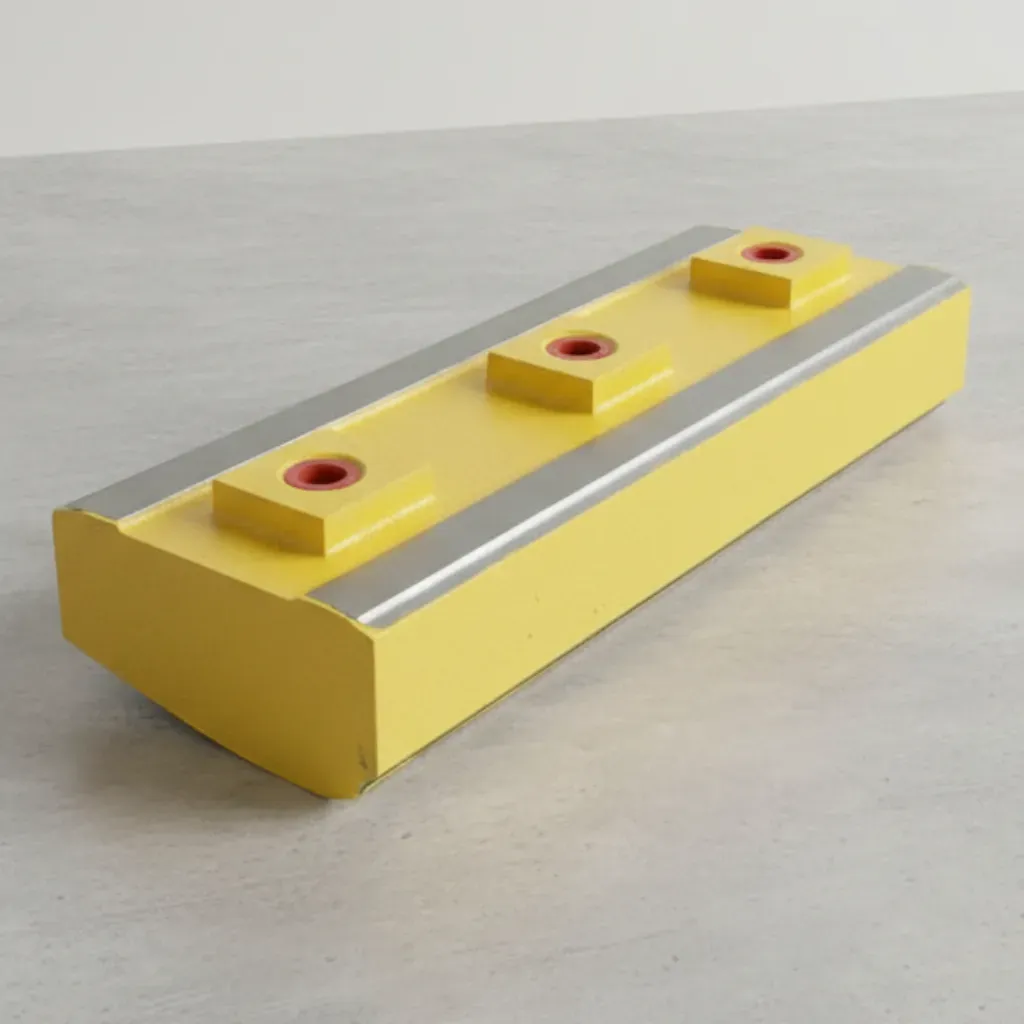
HSI crusher impact plates in manganese steel manufactured by ATF

Manganese steel impact plates for HSI crushers — primary and secondary aprons available in Mn14–Mn22 and high-chrome alloys

Key Features of ATF Impact Plates

Chamber-Specific Profiles

Impact plate profiles matched to primary, secondary, and tertiary chamber positions. Correct angle and curvature ensure proper material flow and product sizing.

Multiple Material Options

Manganese steel (Mn14-Mn18) for impact-heavy applications, high-chrome iron for abrasive feeds, and ceramic MMC for maximum wear life in clean operations.

Adjustable Mounting Systems

Impact plates designed for the specific adjustment mechanism of your crusher model. Maintain correct gap settings as plates wear.

OEM Interchangeability

Direct replacement for Metso, Sandvik, Terex, Kleemann, McCloskey, Hazemag, and other major HSI manufacturers.

Weight-Balanced Sets

Matched sets provided with weight tolerances to prevent vibration issues. Important for multi-plate configurations.

Wear Indicators

Optional wear indicator grooves machined into working surfaces to provide visual cues for replacement timing.

Need Impact Plates for Your HSI Crusher?

Send your crusher model and current plate dimensions for a quote with material recommendations.

Request a Quote

OEM Compatibility

ATF manufactures aftermarket impact plates for all major HSI crusher brands. Parts are engineered to OEM specifications with guaranteed fit.

Metso

  • NP Series (NP1110, NP1213, NP1315, NP1520)
  • Lokotrack LT Series

Sandvik

  • CI Series (CI411, CI511, CI711, CI821)
  • QI Series Mobile

Terex / Powerscreen

  • Finlay Series
  • Trakpactor Series

Kleemann

  • MR Series (MR 110, MR 130, MR 170)

Hazemag

  • AP Series
  • APK Series

McCloskey

  • I Series (I34, I44, I54)
Perguntas frequentes

Impact Plates Perguntas frequentes

Encontre respostas para perguntas comuns sobre impact plates materiais, seleção, manutenção e pedidos. Não encontrou o que procura?

Contatar nossa equipe
How often should impact plates be replaced?
Replacement intervals vary significantly depending on the feed material, crusher model, and chamber position. In clean aggregate operations processing limestone or gravel, impact plates typically last 2-4 times longer than blow bars because they receive lower-energy secondary impacts rather than direct rotor strikes. In recycling or demolition applications with abrasive concrete and rebar, plates may need replacement at intervals comparable to blow bars. Manganese steel plates (Mn14Cr2 per ASTM A128) in primary positions typically achieve 500-1,500 operating hours depending on feed abrasiveness, while high-chrome plates in tertiary positions can exceed 2,000 hours in clean aggregate. Establish baseline wear rates by measuring plate thickness during scheduled maintenance stops. Replace plates when thickness reaches 25-30% of original to prevent wear-through and housing damage. Tracking wear rates per position enables predictive ordering and reduces unplanned downtime.
What causes uneven wear on impact plates?
Uneven wear on impact plates most commonly results from improper feed distribution where material enters the crusher off-center, causing one side of the plate to receive significantly more material flow. This can be caused by misaligned feed conveyors, worn or clogged feed chutes, or segregated material on the feed belt. Worn or incorrectly positioned blow bars also contribute to uneven impact plate wear by directing material asymmetrically into the chamber. Incorrect apron gap settings force material to recirculate in specific zones rather than passing through evenly. Before replacing impact plates, verify that the feed conveyor is centered, blow bars are uniformly worn and correctly indexed in the rotor pockets, and all gap settings match the manufacturer specifications. Also inspect for buildup of compacted fines behind the plates, which can alter the effective plate angle and create localized high-wear zones. Addressing root causes before installing new plates prevents premature and uneven wear on replacement components.
Can impact plates be flipped or rotated?
Most impact plates are designed for single-position use due to asymmetric mounting bolt patterns, tapered profiles, and curvature geometry matched to the specific chamber position. The wear profile on a used plate is typically concave, meaning the reverse side would present the wrong contact angle to incoming material, reducing crushing efficiency and potentially creating material buildup. However, some crusher designs (notably certain Hazemag AP series and older Metso NP models) use symmetric impact plates with centered bolt patterns that allow 180-degree rotation to utilize the unworn end. Before attempting rotation, verify the bolt hole pattern is symmetric, the plate profile is identical on both ends, and the mounting hardware can accommodate the reversed orientation. Even where rotation is possible, the remaining wear life is typically less than 50% of the original because the plate has already thinned from overall abrasion. Always check with ATF engineering or your crusher manual before rotating plates to avoid improper fit.
Should I use the same material for all impact plate positions?
Using a single material across all positions is common for simplicity but is rarely the most cost-effective approach. Primary impact plates closest to the rotor receive high-energy impacts from material ejected at tip speeds of 30-45 m/s, making manganese steel (Mn18Cr2 per ASTM A128 Grade B-3) the preferred choice for its superior work-hardening response under impact loading, reaching surface hardness of 450-500+ BHN in service. Secondary and tertiary plates experience progressively lower impact energy with increasing abrasive sliding contact. In these positions, high-chrome white iron (ASTM A532 Class III, 60-64 HRC) delivers 2-3 times the abrasion life of manganese at comparable cost. For tertiary positions in clean aggregate operations, ceramic-reinforced metal matrix composite (MMC) plates with alumina or silicon carbide inserts rated at 1600 HV can achieve 3-5 times the wear life of plain chrome. A mixed-material strategy matched to the wear mechanism at each position typically reduces total cost per tonne of material processed by 15-30% compared to uniform manganese across all positions.

Conteúdo técnico revisado pela equipe de engenharia da ATF | Especificações metalúrgicas verificadas conforme normas ASTM/ISO

Get a Quote for Impact Plates

Provide your crusher model and we will recommend the right impact plate material for your application.

Contact ATF Engineering
25+
Years Experience
60+
Countries Served
100%
Fit Guarantee

Peças Disponíveis (20)

Hazemag APK40 Impact plate

Hazemag · APK40

SKU: HAZ976 Ver

Hazemag HAZ796 Impact plate

Hazemag · HAZ796

SKU: HAZ796 Ver

Hazemag HAZ797 Impact plate

Hazemag · HAZ797

SKU: HAZ797 Ver

Hazemag HAZ853 Impact plate

Hazemag · HAZ853

SKU: HAZ853 Ver

Kleemann MR-130 Z/R EVO-2 Impact plate

Kleemann · MR-130 Z/R EVO-2

SKU: 709703 Ver

Kleemann MR110Z Impact plate

Kleemann · MR110Z

SKU: MR110Z Ver

Kleemann MR130Z Impact plate

Kleemann · MR130Z

SKU: MR130Z Ver

Metso NP-LT 1213/1313 (NP13) Impact plate

Metso · NP-LT 1213/1313 (NP13)

SKU: NP1213 Std (or with bolts set) Ver

Metso NP-LT 1213/1313 (NP13) Impact plate

Metso · NP-LT 1213/1313 (NP13)

SKU: NP1213 Thicker (or with bolts set) Ver

Metso NP-LT 1007 Impact plate

Metso · NP-LT 1007

SKU: NP1007 Ver

Metso NP-LT 1110 Impact plate

Metso · NP-LT 1110

SKU: NP1110 Ver

Rubblemaster RM100 Impact plate

Rubblemaster · RM100

SKU: RM100 (170058, Grooved) Ver

Rubblemaster RM100 Impact plate

Rubblemaster · RM100

SKU: RM100 (170304, Grooved) Ver

Rubblemaster RM100 Impact plate

Rubblemaster · RM100

SKU: RM100 (175461, Plain) Ver

Rubblemaster RM120 Impact plate

Rubblemaster · RM120

SKU: RM120 (50016001, Grooved) Ver

Rubblemaster RM120 Impact plate

Rubblemaster · RM120

SKU: RM120 (50016002, Plain) Ver

Rubblemaster RM70 Impact plate

Rubblemaster · RM70

SKU: RM70 (176241 Grooved) Ver

Rubblemaster RM70 Impact plate

Rubblemaster · RM70

SKU: RM70 (176242, Plain) Ver

Rubblemaster RM80/90 Impact plate

Rubblemaster · RM80/90

SKU: RM80/90 (174876, Grooved) Ver

Rubblemaster RM80/90 Impact plate

Rubblemaster · RM80/90

SKU: RM80/90 (Plain) Ver

Solicite um Orçamento Gratuito Hoje

Nossa equipe de engenharia responde em 24 horas com especificações detalhadas, recomendações de materiais e preços competitivos.

Resposta em 24 Horas Ajuste OEM Garantido Envio Mundial