

Especificaciones clave
- Material Grades
- Mn14Cr2, Mn18Cr2, High-Chrome Iron, Ceramic MMC
- Hardness Range
- 200-500+ BHN (Mn) / 60-64 HRC (Cr)
- Chamber Positions
- Primary, Secondary, Tertiary
- OEM Brands
- Metso, Sandvik, Terex, Kleemann, Hazemag, McCloskey
- Weight Range
- 50-450 kg per plate
- Standards
- ASTM A128 (Mn steel), ASTM A532 (Cr iron)
- Max Insert Hardness
- 1600 HV (ceramic MMC inserts)
Material Options for Impact Plates
Impact plate material selection depends on the chamber position (primary, secondary, or tertiary), feed material abrasiveness, and whether tramp metal is present. Higher chamber positions receive more impact and less abrasion; lower positions see more abrasion.
| Material | Dureza | Aplicación | Notas |
|---|---|---|---|
| Mn14Cr2 Manganese | 200-220 HB (work-hardens to 400+ HB) | Primary impact plates in demolition and recycling applications with tramp metal | Best impact resistance, lower abrasion life |
| Mn18Cr2 Manganese | 200-240 HB (work-hardens to 500+ HB) | Standard grade for most primary and secondary impact plates | Good balance of impact and abrasion resistance |
| High-Chrome Iron | 60-64 HRC | Secondary and tertiary positions with clean, abrasive feeds | Maximum abrasion resistance, brittle under impact |
| High-Chrome + Ceramic MMC | 60-64 HRC base + 1600 HV inserts | Tertiary impact plates in ultra-abrasive clean aggregate operations | 2-3x wear life vs plain chrome, requires clean feed |
Mn14Cr2 Manganese
Mn18Cr2 Manganese
High-Chrome Iron
High-Chrome + Ceramic MMC
Note: Material recommendations assume proper crusher operation with correct gap settings. Consult ATF engineering for application-specific guidance.
Impact Plates: Secondary Wear Protection for HSI Crushers
Impact plates (also called aprons, breaker plates, or impact curtains) form the stationary crushing surfaces inside HSI crushers. Material ejected from the rotor at high velocity strikes these plates, causing secondary size reduction and shape improvement. The angle, position, and material condition of impact plates directly influence product gradation, crusher efficiency, and overall operating costs. These components are manufactured to ASTM A128 for manganese variants and ASTM A532 for high-chrome compositions. Correct plate geometry ensures proper material trajectory within the chamber, preventing recirculation of oversize particles that increases energy consumption and accelerates wear on other components. Plates are available in thicknesses ranging from 40 mm to 120 mm depending on the crusher model and chamber position.
Unlike blow bars that absorb direct high-velocity impacts, impact plates receive material that has already been partially reduced by the rotor. This shifts the dominant wear mechanism from pure high-energy impact to a combination of abrasion and lower-energy impact, with the ratio depending on chamber position. Primary plates closest to the rotor experience roughly 60% impact and 40% abrasion, while tertiary plates see predominantly abrasive sliding contact. Material selection must account for this gradient. Manganese steel grades (Mn14Cr2, Mn18Cr2) conforming to ASTM A128 are preferred for primary positions due to their work-hardening capacity under impact, while high-chrome irons per ASTM A532 Class III Type A deliver superior abrasion resistance in lower positions where impact energy is insufficient to trigger manganese work-hardening.
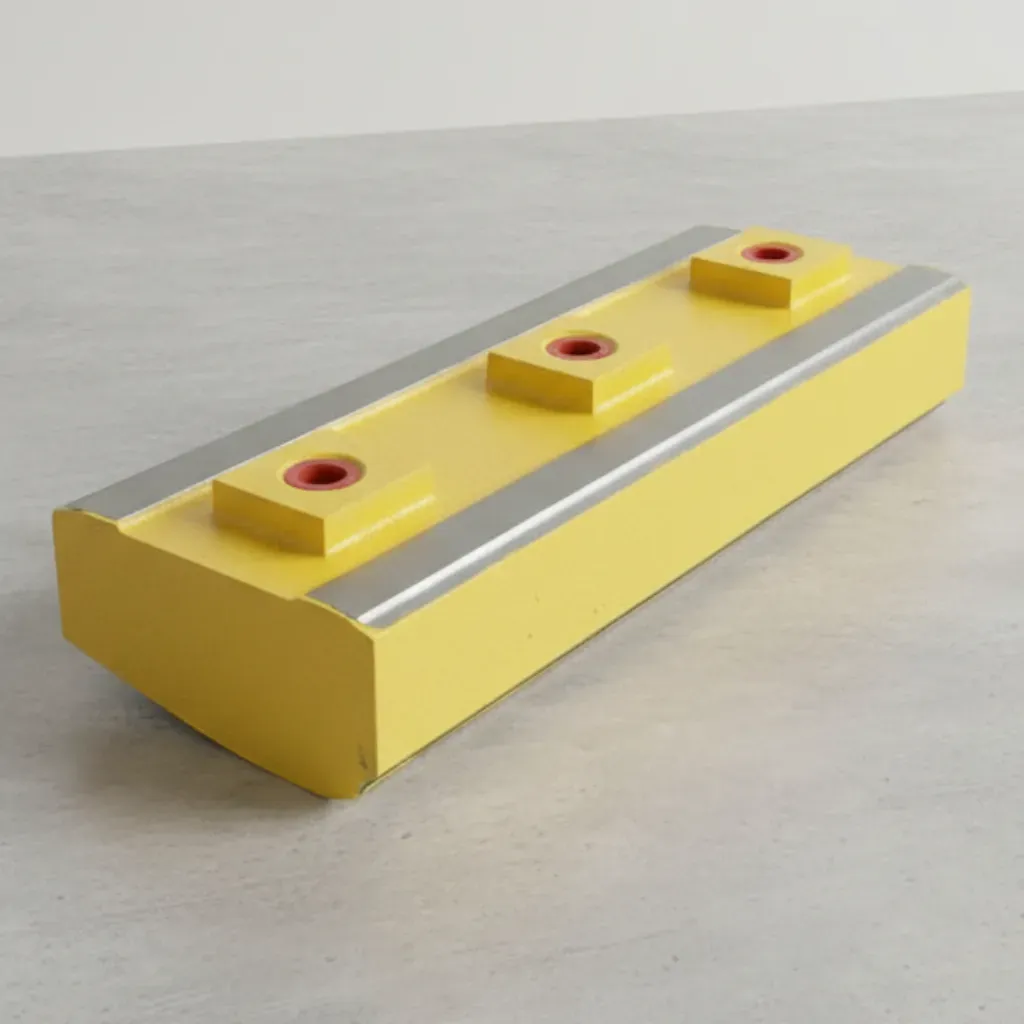
Manganese steel impact plates for HSI crushers — primary and secondary aprons available in Mn14–Mn22 and high-chrome alloys
Key Features of ATF Impact Plates
Chamber-Specific Profiles
Impact plate profiles matched to primary, secondary, and tertiary chamber positions. Correct angle and curvature ensure proper material flow and product sizing.
Multiple Material Options
Manganese steel (Mn14-Mn18) for impact-heavy applications, high-chrome iron for abrasive feeds, and ceramic MMC for maximum wear life in clean operations.
Adjustable Mounting Systems
Impact plates designed for the specific adjustment mechanism of your crusher model. Maintain correct gap settings as plates wear.
OEM Interchangeability
Direct replacement for Metso, Sandvik, Terex, Kleemann, McCloskey, Hazemag, and other major HSI manufacturers.
Weight-Balanced Sets
Matched sets provided with weight tolerances to prevent vibration issues. Important for multi-plate configurations.
Wear Indicators
Optional wear indicator grooves machined into working surfaces to provide visual cues for replacement timing.
Need Impact Plates for Your HSI Crusher?
Send your crusher model and current plate dimensions for a quote with material recommendations.
OEM Compatibility
ATF manufactures aftermarket impact plates for all major HSI crusher brands. Parts are engineered to OEM specifications with guaranteed fit.
Metso
- NP Series (NP1110, NP1213, NP1315, NP1520)
- Lokotrack LT Series
Sandvik
- CI Series (CI411, CI511, CI711, CI821)
- QI Series Mobile
Terex / Powerscreen
- Finlay Series
- Trakpactor Series
Kleemann
- MR Series (MR 110, MR 130, MR 170)
Hazemag
- AP Series
- APK Series
McCloskey
- I Series (I34, I44, I54)
Impact Plates Preguntas frecuentes
Encuentre respuestas a preguntas comunes sobre impact plates materiales, selección, mantenimiento y pedidos. ¿No encuentra lo que busca?
Contactar a nuestro equipoHow often should impact plates be replaced?
What causes uneven wear on impact plates?
Can impact plates be flipped or rotated?
Should I use the same material for all impact plate positions?
Related Parts & Technology
Blow Bars
Rotor-mounted impact elements in martensitic, chrome, and ceramic composite materials.
Más informaciónSide Liners
Housing protection plates that line the crusher side walls.
Más informaciónCeramic Insert Technology
Alumina and ZTA ceramic inserts for extended wear life in abrasive applications. Insert placement, bonding, and material selection.
Más informaciónContenido técnico revisado por el equipo de ingeniería de ATF | Especificaciones metalúrgicas verificadas según normas ASTM/ISO
Get a Quote for Impact Plates
Provide your crusher model and we will recommend the right impact plate material for your application.
Contact ATF Engineering