

Backenbrecher-Teile
Brechbacken | Feste und bewegliche | ATF
Feste und bewegliche Brechbacken in Manganstahl Mn14-Mn22. Zahnprofil, Güte und Dicke nach Kammer, Aufgabegröße und Gesteinshärte.
What Jaw Plates Do and Why Material Matters
Jaw crusher plates (also called jaw dies or jaw liners) are the primary wear components in jaw crushers. The fixed jaw plate mounts to the stationary frame, while the swing jaw plate (or movable jaw) attaches to the pitman and provides the crushing motion. Together, they create the crushing chamber that reduces feed material through compressive force.
Material selection directly determines wear life and cost per tonne. All ATF jaw plates are manufactured from austenitic manganese steel, which work-hardens under the compressive impact of crushing. The key variables are manganese content (affecting work-hardening potential) and chromium content (affecting initial hardness and carbide formation). Higher manganese grades work-harden to higher surface hardness but may be less cost-effective in lower-abrasion applications.
Precision-Cast Jaw Plates
Manufactured to OEM dimensional tolerances
Manganese Grade Selection by Application
Five jaw plate options covering every application from clean limestone to highly abrasive mining feeds.
| Material Grade | Hardness | Impact Tolerance | Typical Application |
|---|---|---|---|
| Mn13Cr2 | 180-220 HB (work-hardens to ~450 HB) | Sehr hoch | Sauberer Kalkstein, weiches Gestein, Recycling mit Fremdmetall |
| Mn14Cr2 | 190-230 HB (work-hardens to ~480 HB) | Sehr hoch | Allgemeiner Steinbruch, Flusskies, moderate Abrasion |
| Mn18Cr2 | 200-240 HB (work-hardens to ~500 HB) | Hoch | Granit, Basalt, hartes Eruptivgestein |
| Mn22Cr2 | 220-260 HB (work-hardens to ~550 HB) | Mittel-hoch | Taconit, Quarzit, hochabrasive Bergbau-Aufgabematerialien |
| Mn22 + TiC Composite | 220-260 HB base + 3200 HV TiC inserts | Mittel-hoch | Extreme Abrasion, bei der reiner Mn22 zu schnell verschleißt |
Standardgüten (2 options)
Mn13Cr2
- Hardness: 180-220 HB (work-hardens to ~450 HB)
- Impact: Sehr hoch
- Application: Sauberer Kalkstein, weiches Gestein, Recycling mit Fremdmetall
Mn14Cr2
- Hardness: 190-230 HB (work-hardens to ~480 HB)
- Impact: Sehr hoch
- Application: Allgemeiner Steinbruch, Flusskies, moderate Abrasion
Premium-Güte (1 options)
Mn18Cr2
- Hardness: 200-240 HB (work-hardens to ~500 HB)
- Impact: Hoch
- Application: Granit, Basalt, hartes Eruptivgestein
Schwerlast (2 options)
Mn22Cr2
- Hardness: 220-260 HB (work-hardens to ~550 HB)
- Impact: Mittel-hoch
- Application: Taconit, Quarzit, hochabrasive Bergbau-Aufgabematerialien
Mn22 + TiC Composite
- Hardness: 220-260 HB base + 3200 HV TiC inserts
- Impact: Mittel-hoch
- Application: Extreme Abrasion, bei der reiner Mn22 zu schnell verschleißt
Note: Work-hardened hardness values are approximate and depend on feed material characteristics, crusher settings, and operating conditions. Higher manganese content enables higher work-hardened hardness but requires sufficient impact energy to achieve full work-hardening. Contact ATF for application-specific guidance.
Work-Hardening Progression by Manganese Grade
Higher manganese grades achieve higher work-hardened surface hardness but require adequate impact energy to activate the work-hardening mechanism. Fine feeds or low-energy applications may not fully work-harden higher grades.
Tooth Profile Selection
Tooth geometry affects grip, fines generation, and wear pattern. Select the profile that matches your feed characteristics.
Standard-Wellung
Allgemeiner Steinbruch, gleichmäßiger Verschleiß
Symmetrisches Zahnmuster bietet ausgewogene Griffigkeit und gleichmäßige Verschleißverteilung. Industriestandard für die meisten Steinbruch-Anwendungen.
Tiefer Zahn
Große Aufgabe, verbesserte Griffigkeit
Tieferes Zahnprofil erhöht die Griffigkeit bei großen Gesteinsbrocken und verbessert den Feinkornauswurf. Ideal für die Primärzerkleinerung von überdimensioniertem Aufgabematerial.
Super Grip
Plattiges oder flaches Material
Aggressive Zahngeometrie verhindert das Durchrutschen von plattigem Material. Entwickelt für die Verarbeitung von plattigem Steinbruch-Gestein oder verwittertem Material.
Flach (Glatt)
Recycling, klebriges Material
Glatte Oberfläche ohne Zähne für das Recycling von Beton und Asphalt. Reduziert Materialanbackungen und Verstopfungen bei klebrigen Aufgabematerialien.
Recycling-Profil
Bau & Abbruch, gemischter Rückbau
Modifizierte Zahngeometrie für Bau- und Abbruchabfälle. Verarbeitet Mischmaterial mit gelegentlichem Fremdmetall.
Custom profiles available. ATF can manufacture tooth profiles to customer drawing for specific applications. Contact us with your requirements for dimensional confirmation and pricing.
How to Choose: Grade First, Then Profile
Jaw plate selection follows two steps. First, identify the correct manganese grade based on feed abrasiveness and impact conditions. Second, select the tooth profile that matches your material characteristics.
1 Step 1 — Manganese Grade by Feed Conditions
Mn13Cr2 / Mn14Cr2
Hoher Schlag, moderate Abrasion
Maximale Zähigkeit mit guter Kaltverfestigung. Beste Schlagfestigkeit für Anwendungen mit häufigem Fremdmetall oder großem Aufgabematerial.
Mn18Cr2
Ausgewogener Schlag und Abrasion
Industriestandard für Granit und Basalt. Höherer Mangangehalt steigert das Kaltverfestigungspotenzial ohne Einbußen bei der Zähigkeit.
Mn22Cr2
Hohe Abrasion, kontrollierter Schlag
Maximale Kaltverfestigung für extrem abrasive Aufgabematerialien. Leicht reduzierte Schlagzähigkeit im Vergleich zu niedrigeren Güten.
Mn22 + TiC Composite
Extreme Abrasion, lange Kampagnen
TiC-Einsätze (3200 HV) bieten lokale Härte an der Brechfläche. Verlängert die Standzeit, wenn reiner Mn22 zu schnell verschleißt.
Not sure which grade fits your application?
Send your feed material description and crusher model — ATF recommends the right grade within 24 hours.
2 Step 2 — TiC Composite Upgrade
TiC (titanium carbide) rods embedded in the crushing face provide localised hardness of 3200 HV. This composite option is available on Mn22 base plates for applications where plain manganese wears too fast.
When to Upgrade to TiC
- Reine Mn22-Platten verschleißen 40%+ schneller als die Zielkampagne
- Hochsiliziumhaltiges Aufgabematerial (>70% SiO2)
- Ziel: Verlängerung der Stillstandsintervalle
- Kosten-pro-Tonne-Berechnungen sprechen für längere Standzeit
When NOT to Use TiC
- Häufiges großes Fremdmetall im Aufgabematerial
- Klebriges oder tongebundenes Material, das sich an der Brechfläche aufbaut
- Ausreichende Standzeit bereits mit reinem Manganstahl erreicht
- Anwendungen, bei denen der TiC-Aufpreis den Standzeit-Vorteil übersteigt
Lead Times by Material Grade
| Material Grade | Typical Lead Time | Why |
|---|---|---|
| Mn13Cr2 / Mn14Cr2 (plain) | 2-3 weeks | Großserienproduktion, häufig auf Lager |
| Mn18Cr2 (plain) | 2-4 weeks | Standardmäßige Produktionsplanung |
| Mn22Cr2 (plain) | 3-4 weeks | Spezielle Wärmebehandlung erforderlich |
| Mn22 + TiC Composite | 5-7 weeks | TiC-Stabplatzierung erfordert einen sekundären Gussprozess |
Lead times vary by plate dimensions, order quantity, and current production schedule. Confirm lead time at order placement. Standard Mn18 plates for Metso C-Series and Sandvik CJ models are typically available from stock.
Planning a shutdown?
Check lead time and stock availability for your specific jaw plate dimensions.
Mn13Cr2 & Mn14Cr2 Jaw Plates
Mn13Cr2 and Mn14Cr2 provide the highest impact tolerance of any manganese grade. These standard grades work-harden to approximately 450-480 HB under compressive impact — sufficient for most aggregates and recycling applications without the cost premium of higher grades.
Recommended applications: Clean limestone and dolomite, recycling operations with tramp metal risk, portable crushing operations where material varies, and any application where maximum toughness is prioritised over maximum work-hardened hardness.
When to Use Lower Grades
Mn13/Mn14 is often the correct choice even when higher grades are available. If your current plates deliver acceptable wear life without cracking, upgrading to Mn18 or Mn22 may not be cost-effective. The higher grades are reserved for genuinely abrasive feeds where lower grades wear excessively fast.
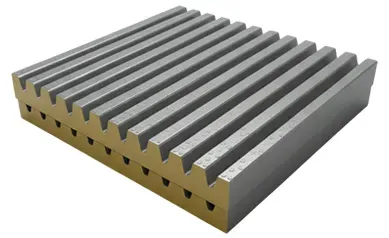
Standard Manganese Jaw Plates
Mn13Cr2 / Mn14Cr2 for balanced performance
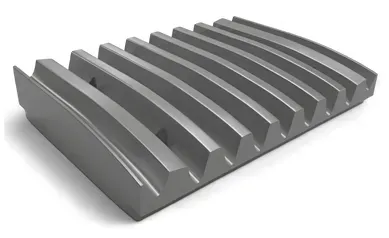
Mn18Cr2 Premium Grade
Industry standard for granite and basalt
Mn18Cr2 Jaw Plates
Mn18Cr2 (ASTM A128 Grade C equivalent) is the industry standard for hard rock quarrying. The increased manganese content enables work-hardening to approximately 500 HB while retaining high impact tolerance. This grade represents the optimal balance for granite, basalt, gabbro, and similar hard igneous rock.
Work-hardening mechanism: Under the compressive impact of crushing, the austenitic structure undergoes strain-induced transformation. The surface progressively hardens while the core remains tough, providing both abrasion resistance and impact absorption.
- Granite, basalt, gabbro, diorite
- River gravel and alluvial deposits
- Mixed hard rock quarrying
Mn22Cr2 Heavy Duty Jaw Plates
Mn22Cr2 provides the highest work-hardening potential of any standard manganese grade, achieving approximately 550 HB surface hardness under optimal conditions. This grade is reserved for highly abrasive mining feeds where Mn18 wears excessively fast.
Typical applications: Taconite (iron ore), quartzite, high-silica aggregates, and other materials with silica content exceeding 70%. Impact tolerance is slightly reduced compared to Mn18 — this is an acceptable trade-off when abrasion is the dominant wear mechanism.
Important Consideration
Mn22 requires sufficient impact energy to achieve full work-hardening. In low-impact applications (fine feeds, low crusher speed), the surface may not harden fully, and Mn18 may provide equivalent performance at lower cost. Verify that the application generates adequate impact before specifying Mn22.
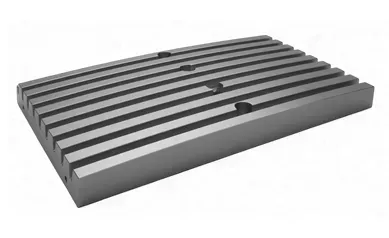
Mn22Cr2 Heavy Duty Grade
Maximum work-hardening for abrasive feeds


Mn22 + TiC Composite
Titanium carbide rods at 3200 HV
Mn22 + TiC Composite Jaw Plates
TiC (titanium carbide) rods embedded in the crushing face provide localised hardness of 3200 HV — significantly harder than any work-hardened manganese surface. The Mn22 base retains its impact tolerance while the TiC rods resist edge rounding in extremely abrasive feeds.
The TiC upgrade is justified when: Plain Mn22 plates wear 40% or more faster than required campaign length, and the cost premium of TiC is offset by reduced changeout frequency and extended production time between shutdowns.
TiC vs Plain Manganese
TiC composite plates typically provide 1.5-2.5x the wear life of plain Mn22 in highly abrasive applications. The actual improvement depends on feed silica content, particle size, and crushing parameters. ATF provides application-specific recommendations based on operating conditions.
Jaw Plate Gallery
Fixed and swing jaw plates manufactured to OEM specifications for all major jaw crusher brands.
-
Mn18Cr2 Fixed Jaw Plate
-
Primary Swing Jaw Plate
-
Mn22Cr2 Heavy Duty Plates
-
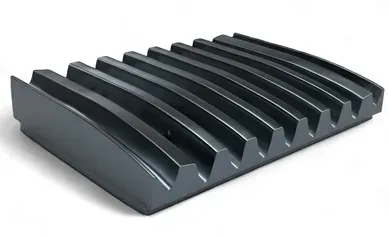
Deep Tooth Tooth Profile Detail
-
TiC Insert Mn22 + TiC Composite
-
Composite TiC Insert Pattern
Not Sure Which Grade is Right?
Our application engineers provide free technical consultations. Tell us your crusher model, feed material, and current wear patterns — we'll recommend the optimal jaw plate grade for your operation.
Plate Flipping and Wear Management
Plate Flipping Schedule
| Wear Stage | Action | Purpose |
|---|---|---|
| 30-40% verschlissen | Feste Platte um 180° wenden | Legt die unverschlissene Brechfläche frei, verdoppelt die nutzbare Standzeit |
| 50-60% verschlissen (gesamt) | Schwinge um 180° wenden | Die Schwinge verschleißt typischerweise am Austragsende schneller |
| CSS nähert sich dem Minimum | Beide Platten ersetzen | Verschlissene Platten können das sichere Spaltmaß nicht mehr einhalten |
Before Flipping
Always inspect plates for cracks before flipping. Cracked plates should be replaced, not flipped — a crack may propagate under continued stress and cause catastrophic failure. Check mounting bolt holes for elongation or damage.
CSS Monitoring & Wear Indicators
Vergröberung der Produktkörnung
Cause: Plattenverschleiß vergrößert das CSS
Action: CSS anpassen oder Plattenwechsel planen
Reduzierter Durchsatz
Cause: Verschleiß beeinträchtigt die Brecheffizienz
Action: Plattenprofile prüfen, Austausch erwägen
Ungleichmäßiges Verschleißmuster
Cause: Aufgabe-Segregation oder Fehlausrichtung
Action: Aufgabeverteilung inspizieren, Backenausrichtung prüfen
Material rutscht durch
Cause: Zähne glatt verschlissen (Glasierung)
Action: Platten ersetzen, Greifwinkel-Spezifikation prüfen
Nip Angle and Material Grip
The nip angle is the angle between the fixed and swing jaw faces. For most rock types, the nip angle should be between 19° and 23° to ensure material is gripped without slipping. Worn plates with reduced tooth height effectively increase the nip angle, causing material to slip rather than being crushed.
If material begins slipping despite CSS being within specification, the plate tooth profile has worn too smooth. Replace plates to restore proper grip. Deeper tooth profiles may be specified for slabby or difficult-to-grip materials.
19°–23°
Optimal Nip Angle Range
Varies by material type
Common Jaw Plate Problems and Solutions
Platten reißen oder brechen
Possible Causes:
- Fremdmetall-Einschlag
- Fehlerhafte Wärmebehandlung
- Zu festes Anziehen der Befestigungsschrauben
Recommended Solutions:
- Metalldetektion stromaufwärts verbessern
- Legierungsspezifikation auf Anwendung prüfen
- OEM-Drehmomentspezifikationen einhalten
Vorzeitiger Verschleiß (kürzere als erwartete Standzeit)
Possible Causes:
- Aufgabematerial abrasiver als erwartet
- Falsche Mangangüte gewählt
- Unzureichende Kaltverfestigung (feines Aufgabematerial)
Recommended Solutions:
- Auf höhere Mn-Güte oder TiC upgraden
- Aufgabematerial-Analyse überprüfen
- Ausreichende Schlagenergie an der Brechfläche sicherstellen
Ungleichmäßiger Verschleiß über die Plattenfläche
Possible Causes:
- Segregierte Aufgabeverteilung
- Backenrahmen-Fehlausrichtung
- Einkornaufgabe erzeugt Punktbelastung
Recommended Solutions:
- Aufgabe-Verteilerplatte installieren
- Rahmenausrichtung prüfen und unterkeilen
- Aufgabegrößen möglichst mischen
Materialrutschen / schlechte Griffigkeit
Possible Causes:
- Verschlissenes Zahnprofil
- Greifwinkel zu flach
- Platte zu glatt für den Materialtyp
Recommended Solutions:
- Platten vor vollständigem Zahnverschleiß ersetzen
- Backenwinkel-Spezifikation prüfen
- Tieferes Zahnprofil in Betracht ziehen
Glasierung (Oberfläche härtet nicht)
Possible Causes:
- Aufgabematerial zu fein für Backenbrecher
- Schlagenergie zu gering
- Mn-Güte zu hoch für die Anwendung
Recommended Solutions:
- Feinkorn vorabsieben, gröberes Material aufgeben
- Aufgaberate prüfen, Choke-Feed beibehalten
- Niedrigere Mn-Güte erwägen (Mn13/14)
Übermäßiges Feinkorn im Produkt
Possible Causes:
- Platten über die Grenze hinaus verschlissen
- CSS zu eng
- Nachzerkleinerung des Produkts am Austrag
Recommended Solutions:
- Platten ersetzen, um das Profil wiederherzustellen
- CSS gemäß Spezifikation erweitern
- Austragsrutsche auf Verstopfungen prüfen
Compatible Crusher Models
ATF jaw plates are manufactured to the dimensional tolerances of the following jaw crusher lines. Material recommendations based on typical application — confirm with ATF for specific operating conditions.
| OEM | Models | Recommended Grade |
|---|---|---|
| Metso | C80 C96 C100 C106 C110 C116 C120 C125 C130 C140 C145 C150 C160 C200 | Mn18 for standard quarrying, Mn22 for abrasive feeds |
| Sandvik | CJ211 CJ411 CJ412 CJ612 CJ613 CJ615 CJ815 UJ210 UJ310 UJ440i | Mn18 for granite/basalt, Mn14 for recycling |
| Terex Finlay | J-960 J-1160 J-1170 J-1175 J-1170AS J-1480 | Mn18 general quarrying |
| Kleemann | MC 100 MC 110 MC 120 MC 125 MC 140 MOBICAT | Mn18 standard, Mn22 for mining |
| McCloskey | J35 J40 J45 J50 J67 | Mn14 recycling, Mn18 quarry |
| Komatsu | BR380JG BR480RG BR550JG | Mn18 general purpose |
| Telsmith | 2238 2550 3042 3244 3442 3448 4448 5160 5163 | Mn18 standard, Mn22+TiC for taconite |
| Lippmann | 3042 3650 4248 5062 | Mn22 for hard rock mining |
| Eagle | 500 1000 1200 1400 2036 2238 2442 3042 | Mn18 aggregate, Mn22 mining |
| KPI-JCI | KODIAK K300 K400 K500 PIONEER 3042 4030 5060 | Mn18 general purpose |
Model not listed? Contact ATF with the part number or jaw dimensions. Most jaw plates can be manufactured to drawing within 3–5 weeks.
Jaw Plate Dimensions and Specifications
Critical dimensions for jaw plate fit: length, width, thickness, mounting hole pattern, and tooth profile. ATF requires at least one of the following to confirm dimensional fit:
-
OEM Part Number
e.g. Metso 814328513400
-
Crusher Model & Serial
For cross-reference to OEM specs
-
Dimensional Drawing
With tolerances specified
-
Physical Measurement
L × W × T, hole pattern, tooth pitch
Jaw plates should be ordered as matched sets (fixed + swing) to ensure consistent crushing performance and even wear. Mixing old and new plates creates uneven wear patterns and may affect product gradation.
Quick Quote Requirements
- Crusher brand and model
- Part number or dimensions
- Feed material type
- Current grade / wear issues
- Quantity (typically matched sets)
Not sure about specifications? Send photos of your worn plates and crusher nameplate — our engineers can identify the correct parts.
Get a QuoteReady to order?
Send your OEM part number or jaw drawing for dimensional confirmation and pricing.
Jaw Plate FAQs
Find answers to common questions about jaw plate materials, selection, maintenance, and ordering. Can't find what you're looking for?
Contact Our TeamWhat is the difference between fixed and swing jaw plates?
How do I choose between Mn14, Mn18, and Mn22 grades?
When should I upgrade to TiC composite jaw plates?
Can jaw plates be flipped to extend wear life?
How do I measure the correct CSS (closed-side setting)?
What information does ATF need to quote jaw plates?
Ready to Order Jaw Plates?
Stock available for popular models. Custom orders manufactured in 3–5 weeks. Factory-direct pricing with technical support from experienced engineers.
24h
Quote Response
3–5
Weeks Production
50+
Countries Served
Fordern Sie Noch Heute ein Kostenloses Angebot An
Unser Ingenieurteam antwortet innerhalb von 24 Stunden mit detaillierten Spezifikationen, Materialempfehlungen und wettbewerbsfähigen Preisen.