

Repuestos para Chancador de Mandíbula
Placas de Mandíbula | Fija y Oscilante | ATF
Placas de mandíbula fija y oscilante en manganeso Mn14-Mn22. Perfil de diente, grado y espesor según cámara, tamaño de alimentación y dureza de roca.
What Jaw Plates Do and Why Material Matters
Jaw crusher plates (also called jaw dies or jaw liners) are the primary wear components in jaw crushers. The fixed jaw plate mounts to the stationary frame, while the swing jaw plate (or movable jaw) attaches to the pitman and provides the crushing motion. Together, they create the crushing chamber that reduces feed material through compressive force.
Material selection directly determines wear life and cost per tonne. All ATF jaw plates are manufactured from austenitic manganese steel, which work-hardens under the compressive impact of crushing. The key variables are manganese content (affecting work-hardening potential) and chromium content (affecting initial hardness and carbide formation). Higher manganese grades work-harden to higher surface hardness but may be less cost-effective in lower-abrasion applications.
Precision-Cast Jaw Plates
Manufactured to OEM dimensional tolerances
Manganese Grade Selection by Application
Five jaw plate options covering every application from clean limestone to highly abrasive mining feeds.
| Material Grade | Hardness | Impact Tolerance | Typical Application |
|---|---|---|---|
| Mn13Cr2 | 180-220 HB (work-hardens to ~450 HB) | Muy alta | Caliza limpia, roca blanda, reciclaje con metal residual |
| Mn14Cr2 | 190-230 HB (work-hardens to ~480 HB) | Muy alta | Cantera general, grava de río, abrasión moderada |
| Mn18Cr2 | 200-240 HB (work-hardens to ~500 HB) | Alta | Granito, basalto, roca ígnea dura |
| Mn22Cr2 | 220-260 HB (work-hardens to ~550 HB) | Media-alta | Taconita, cuarcita, alimentaciones mineras altamente abrasivas |
| Mn22 + TiC Composite | 220-260 HB base + 3200 HV TiC inserts | Media-alta | Abrasión extrema donde el Mn22 simple se desgasta demasiado rápido |
Grados estándar (2 options)
Mn13Cr2
- Hardness: 180-220 HB (work-hardens to ~450 HB)
- Impact: Muy alta
- Application: Caliza limpia, roca blanda, reciclaje con metal residual
Mn14Cr2
- Hardness: 190-230 HB (work-hardens to ~480 HB)
- Impact: Muy alta
- Application: Cantera general, grava de río, abrasión moderada
Grado premium (1 options)
Mn18Cr2
- Hardness: 200-240 HB (work-hardens to ~500 HB)
- Impact: Alta
- Application: Granito, basalto, roca ígnea dura
Servicio pesado (2 options)
Mn22Cr2
- Hardness: 220-260 HB (work-hardens to ~550 HB)
- Impact: Media-alta
- Application: Taconita, cuarcita, alimentaciones mineras altamente abrasivas
Mn22 + TiC Composite
- Hardness: 220-260 HB base + 3200 HV TiC inserts
- Impact: Media-alta
- Application: Abrasión extrema donde el Mn22 simple se desgasta demasiado rápido
Note: Work-hardened hardness values are approximate and depend on feed material characteristics, crusher settings, and operating conditions. Higher manganese content enables higher work-hardened hardness but requires sufficient impact energy to achieve full work-hardening. Contact ATF for application-specific guidance.
Work-Hardening Progression by Manganese Grade
Higher manganese grades achieve higher work-hardened surface hardness but require adequate impact energy to activate the work-hardening mechanism. Fine feeds or low-energy applications may not fully work-harden higher grades.
Tooth Profile Selection
Tooth geometry affects grip, fines generation, and wear pattern. Select the profile that matches your feed characteristics.
Corrugado estándar
Cantera general, desgaste uniforme
El patrón de dientes simétrico proporciona un agarre equilibrado y una distribución uniforme del desgaste. Estándar de la industria para la mayoría de las aplicaciones de cantera.
Diente profundo
Alimentación grande, mejor agarre
El perfil de diente más profundo aumenta el agarre en rocas grandes y mejora la expulsión de finos. Ideal para el chancado primario de alimentación sobredimensionada.
Super Grip
Material plano o en láminas
La geometría agresiva del diente evita que el material plano se deslice. Diseñado para procesar roca de cantera en láminas o material meteorizado.
Plano (Liso)
Reciclaje, material pegajoso
Cara lisa sin dientes para reciclaje de concreto y asfalto. Reduce la acumulación de material y los atascos en alimentaciones pegajosas.
Perfil de reciclaje
Demolición y construcción, demolición mixta
Geometría de diente modificada para residuos de construcción y demolición. Maneja alimentaciones mixtas con metal residual ocasional.
Custom profiles available. ATF can manufacture tooth profiles to customer drawing for specific applications. Contact us with your requirements for dimensional confirmation and pricing.
How to Choose: Grade First, Then Profile
Jaw plate selection follows two steps. First, identify the correct manganese grade based on feed abrasiveness and impact conditions. Second, select the tooth profile that matches your material characteristics.
1 Step 1 — Manganese Grade by Feed Conditions
Mn13Cr2 / Mn14Cr2
Alto impacto, abrasión moderada
Máxima tenacidad con buen endurecimiento por trabajo. Mejor resistencia al impacto para aplicaciones con metal residual frecuente o alimentación de gran tamaño.
Mn18Cr2
Impacto y abrasión equilibrados
Estándar de la industria para granito y basalto. El mayor contenido de manganeso aumenta el potencial de endurecimiento por trabajo sin sacrificar la tenacidad.
Mn22Cr2
Alta abrasión, impacto controlado
Máximo endurecimiento por trabajo para alimentaciones extremadamente abrasivas. Tolerancia al impacto ligeramente reducida en comparación con grados inferiores.
Mn22 + TiC Composite
Abrasión extrema, campañas prolongadas
Los insertos de TiC (3200 HV) proporcionan dureza localizada en la cara de chancado. Extiende la vida útil donde el Mn22 simple se desgasta demasiado rápido.
Not sure which grade fits your application?
Send your feed material description and crusher model — ATF recommends the right grade within 24 hours.
2 Step 2 — TiC Composite Upgrade
TiC (titanium carbide) rods embedded in the crushing face provide localised hardness of 3200 HV. This composite option is available on Mn22 base plates for applications where plain manganese wears too fast.
When to Upgrade to TiC
- Las placas de Mn22 simple se desgastan un 40%+ más rápido que la campaña objetivo
- Alimentaciones altamente silíceas (>70% SiO2)
- Objetivo de extender los intervalos de parada
- Los cálculos de costo por tonelada favorecen un mayor desgaste
When NOT to Use TiC
- Metal residual grande y frecuente en la alimentación
- Material pegajoso o arcilloso que se acumula en la cara de chancado
- Vida útil adecuada ya lograda con manganeso simple
- Aplicaciones donde el sobrecosto del TiC supera el beneficio de vida útil
Lead Times by Material Grade
| Material Grade | Typical Lead Time | Why |
|---|---|---|
| Mn13Cr2 / Mn14Cr2 (plain) | 2-3 weeks | Producción en alto volumen, comúnmente disponible en stock |
| Mn18Cr2 (plain) | 2-4 weeks | Programación de producción estándar |
| Mn22Cr2 (plain) | 3-4 weeks | Se requiere tratamiento térmico especializado |
| Mn22 + TiC Composite | 5-7 weeks | La colocación de varillas de TiC requiere un proceso de fundición secundario |
Lead times vary by plate dimensions, order quantity, and current production schedule. Confirm lead time at order placement. Standard Mn18 plates for Metso C-Series and Sandvik CJ models are typically available from stock.
Planning a shutdown?
Check lead time and stock availability for your specific jaw plate dimensions.
Mn13Cr2 & Mn14Cr2 Jaw Plates
Mn13Cr2 and Mn14Cr2 provide the highest impact tolerance of any manganese grade. These standard grades work-harden to approximately 450-480 HB under compressive impact — sufficient for most aggregates and recycling applications without the cost premium of higher grades.
Recommended applications: Clean limestone and dolomite, recycling operations with tramp metal risk, portable crushing operations where material varies, and any application where maximum toughness is prioritised over maximum work-hardened hardness.
When to Use Lower Grades
Mn13/Mn14 is often the correct choice even when higher grades are available. If your current plates deliver acceptable wear life without cracking, upgrading to Mn18 or Mn22 may not be cost-effective. The higher grades are reserved for genuinely abrasive feeds where lower grades wear excessively fast.
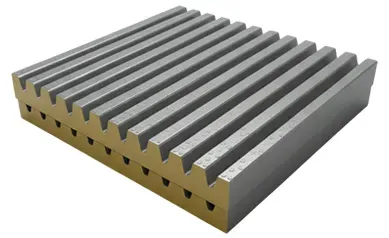
Standard Manganese Jaw Plates
Mn13Cr2 / Mn14Cr2 for balanced performance
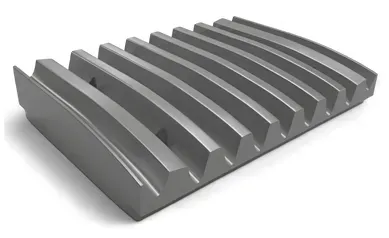
Mn18Cr2 Premium Grade
Industry standard for granite and basalt
Mn18Cr2 Jaw Plates
Mn18Cr2 (ASTM A128 Grade C equivalent) is the industry standard for hard rock quarrying. The increased manganese content enables work-hardening to approximately 500 HB while retaining high impact tolerance. This grade represents the optimal balance for granite, basalt, gabbro, and similar hard igneous rock.
Work-hardening mechanism: Under the compressive impact of crushing, the austenitic structure undergoes strain-induced transformation. The surface progressively hardens while the core remains tough, providing both abrasion resistance and impact absorption.
- Granite, basalt, gabbro, diorite
- River gravel and alluvial deposits
- Mixed hard rock quarrying
Mn22Cr2 Heavy Duty Jaw Plates
Mn22Cr2 provides the highest work-hardening potential of any standard manganese grade, achieving approximately 550 HB surface hardness under optimal conditions. This grade is reserved for highly abrasive mining feeds where Mn18 wears excessively fast.
Typical applications: Taconite (iron ore), quartzite, high-silica aggregates, and other materials with silica content exceeding 70%. Impact tolerance is slightly reduced compared to Mn18 — this is an acceptable trade-off when abrasion is the dominant wear mechanism.
Important Consideration
Mn22 requires sufficient impact energy to achieve full work-hardening. In low-impact applications (fine feeds, low crusher speed), the surface may not harden fully, and Mn18 may provide equivalent performance at lower cost. Verify that the application generates adequate impact before specifying Mn22.
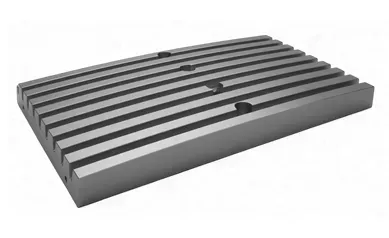
Mn22Cr2 Heavy Duty Grade
Maximum work-hardening for abrasive feeds


Mn22 + TiC Composite
Titanium carbide rods at 3200 HV
Mn22 + TiC Composite Jaw Plates
TiC (titanium carbide) rods embedded in the crushing face provide localised hardness of 3200 HV — significantly harder than any work-hardened manganese surface. The Mn22 base retains its impact tolerance while the TiC rods resist edge rounding in extremely abrasive feeds.
The TiC upgrade is justified when: Plain Mn22 plates wear 40% or more faster than required campaign length, and the cost premium of TiC is offset by reduced changeout frequency and extended production time between shutdowns.
TiC vs Plain Manganese
TiC composite plates typically provide 1.5-2.5x the wear life of plain Mn22 in highly abrasive applications. The actual improvement depends on feed silica content, particle size, and crushing parameters. ATF provides application-specific recommendations based on operating conditions.
Jaw Plate Gallery
Fixed and swing jaw plates manufactured to OEM specifications for all major jaw crusher brands.
-
Mn18Cr2 Fixed Jaw Plate
-
Primary Swing Jaw Plate
-
Mn22Cr2 Heavy Duty Plates
-
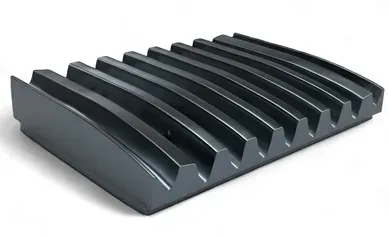
Deep Tooth Tooth Profile Detail
-
TiC Insert Mn22 + TiC Composite
-
Composite TiC Insert Pattern
Not Sure Which Grade is Right?
Our application engineers provide free technical consultations. Tell us your crusher model, feed material, and current wear patterns — we'll recommend the optimal jaw plate grade for your operation.
Plate Flipping and Wear Management
Plate Flipping Schedule
| Wear Stage | Action | Purpose |
|---|---|---|
| 30-40% desgastada | Voltear placa fija 180° | Expone la cara de chancado sin desgaste, duplica la vida útil |
| 50-60% desgastada (total) | Voltear mandíbula oscilante 180° | La mandíbula oscilante generalmente se desgasta más rápido en el extremo de descarga |
| CSS acercándose al mínimo | Reemplazar ambas placas | Las placas desgastadas no pueden mantener el ajuste seguro del lado cerrado |
Before Flipping
Always inspect plates for cracks before flipping. Cracked plates should be replaced, not flipped — a crack may propagate under continued stress and cause catastrophic failure. Check mounting bolt holes for elongation or damage.
CSS Monitoring & Wear Indicators
Engrosamiento de la granulometría del producto
Cause: El desgaste de la placa aumenta el CSS
Action: Ajustar el CSS o planificar el cambio de placa
Reducción del rendimiento
Cause: El desgaste afecta la eficiencia de chancado
Action: Verificar perfiles de placa, considerar reemplazo
Patrón de desgaste desigual
Cause: Segregación de alimentación o desalineación
Action: Inspeccionar distribución de alimentación, verificar alineación de mandíbula
Deslizamiento de material
Cause: Dientes desgastados lisos (glaseo)
Action: Reemplazar placas, verificar especificación del ángulo de agarre
Nip Angle and Material Grip
The nip angle is the angle between the fixed and swing jaw faces. For most rock types, the nip angle should be between 19° and 23° to ensure material is gripped without slipping. Worn plates with reduced tooth height effectively increase the nip angle, causing material to slip rather than being crushed.
If material begins slipping despite CSS being within specification, the plate tooth profile has worn too smooth. Replace plates to restore proper grip. Deeper tooth profiles may be specified for slabby or difficult-to-grip materials.
19°–23°
Optimal Nip Angle Range
Varies by material type
Common Jaw Plate Problems and Solutions
Placas agrietadas o rotas
Possible Causes:
- Impacto de metal residual
- Tratamiento térmico incorrecto
- Apriete excesivo de pernos de montaje
Recommended Solutions:
- Mejorar la detección de metales aguas arriba
- Verificar que la especificación de aleación coincida con la aplicación
- Seguir las especificaciones de torque OEM
Desgaste prematuro (vida más corta de lo esperado)
Possible Causes:
- Alimentación más abrasiva de lo previsto
- Grado de manganeso incorrecto seleccionado
- Endurecimiento por trabajo insuficiente (alimentación fina)
Recommended Solutions:
- Actualizar a un grado de Mn más alto o TiC
- Revisar el análisis del material de alimentación
- Asegurar energía de impacto adecuada en la cara de chancado
Desgaste desigual en la cara de la placa
Possible Causes:
- Distribución segregada de alimentación
- Desalineación del bastidor de mandíbula
- Alimentación de tamaño único creando carga puntual
Recommended Solutions:
- Instalar placa de distribución de alimentación
- Verificar y calzar la alineación del bastidor
- Mezclar tamaños de alimentación cuando sea posible
Deslizamiento de material / agarre deficiente
Possible Causes:
- Perfil de diente desgastado
- Ángulo de agarre demasiado superficial
- Placa demasiado lisa para el tipo de material
Recommended Solutions:
- Reemplazar placas antes de que los dientes se desgasten completamente
- Verificar especificación del ángulo de mandíbula
- Considerar perfil de diente más profundo
Glaseo (la superficie no se endurece)
Possible Causes:
- Alimentación demasiado fina para chancador de mandíbula
- Energía de impacto demasiado baja
- Grado de Mn demasiado alto para la aplicación
Recommended Solutions:
- Pre-cribar finos, alimentar material más grueso
- Verificar tasa de alimentación para mantener alimentación choke
- Considerar grado de Mn más bajo (Mn13/14)
Finos excesivos en el producto
Possible Causes:
- Placas desgastadas más allá del límite
- CSS demasiado ajustado
- Re-chancado del producto en la descarga
Recommended Solutions:
- Reemplazar placas para restaurar el perfil
- Ampliar CSS según especificación
- Verificar el chute de descarga para detectar bloqueos
Compatible Crusher Models
ATF jaw plates are manufactured to the dimensional tolerances of the following jaw crusher lines. Material recommendations based on typical application — confirm with ATF for specific operating conditions.
| OEM | Models | Recommended Grade |
|---|---|---|
| Metso | C80 C96 C100 C106 C110 C116 C120 C125 C130 C140 C145 C150 C160 C200 | Mn18 for standard quarrying, Mn22 for abrasive feeds |
| Sandvik | CJ211 CJ411 CJ412 CJ612 CJ613 CJ615 CJ815 UJ210 UJ310 UJ440i | Mn18 for granite/basalt, Mn14 for recycling |
| Terex Finlay | J-960 J-1160 J-1170 J-1175 J-1170AS J-1480 | Mn18 general quarrying |
| Kleemann | MC 100 MC 110 MC 120 MC 125 MC 140 MOBICAT | Mn18 standard, Mn22 for mining |
| McCloskey | J35 J40 J45 J50 J67 | Mn14 recycling, Mn18 quarry |
| Komatsu | BR380JG BR480RG BR550JG | Mn18 general purpose |
| Telsmith | 2238 2550 3042 3244 3442 3448 4448 5160 5163 | Mn18 standard, Mn22+TiC for taconite |
| Lippmann | 3042 3650 4248 5062 | Mn22 for hard rock mining |
| Eagle | 500 1000 1200 1400 2036 2238 2442 3042 | Mn18 aggregate, Mn22 mining |
| KPI-JCI | KODIAK K300 K400 K500 PIONEER 3042 4030 5060 | Mn18 general purpose |
Model not listed? Contact ATF with the part number or jaw dimensions. Most jaw plates can be manufactured to drawing within 3–5 weeks.
Jaw Plate Dimensions and Specifications
Critical dimensions for jaw plate fit: length, width, thickness, mounting hole pattern, and tooth profile. ATF requires at least one of the following to confirm dimensional fit:
-
OEM Part Number
e.g. Metso 814328513400
-
Crusher Model & Serial
For cross-reference to OEM specs
-
Dimensional Drawing
With tolerances specified
-
Physical Measurement
L × W × T, hole pattern, tooth pitch
Jaw plates should be ordered as matched sets (fixed + swing) to ensure consistent crushing performance and even wear. Mixing old and new plates creates uneven wear patterns and may affect product gradation.
Quick Quote Requirements
- Crusher brand and model
- Part number or dimensions
- Feed material type
- Current grade / wear issues
- Quantity (typically matched sets)
Not sure about specifications? Send photos of your worn plates and crusher nameplate — our engineers can identify the correct parts.
Get a QuoteReady to order?
Send your OEM part number or jaw drawing for dimensional confirmation and pricing.
Jaw Plate FAQs
Find answers to common questions about jaw plate materials, selection, maintenance, and ordering. Can't find what you're looking for?
Contact Our TeamWhat is the difference between fixed and swing jaw plates?
How do I choose between Mn14, Mn18, and Mn22 grades?
When should I upgrade to TiC composite jaw plates?
Can jaw plates be flipped to extend wear life?
How do I measure the correct CSS (closed-side setting)?
What information does ATF need to quote jaw plates?
Ready to Order Jaw Plates?
Stock available for popular models. Custom orders manufactured in 3–5 weeks. Factory-direct pricing with technical support from experienced engineers.
24h
Quote Response
3–5
Weeks Production
50+
Countries Served
Solicite una Cotización Gratuita Hoy
Nuestro equipo de ingeniería responde en 24 horas con especificaciones detalladas, recomendaciones de materiales y precios competitivos.