

Vertikal-Rollenmühle-Teile
VRM-Mahlwalzen | ATF
Mahlwalzen für VRM in Hochchrom-Auftragsschweißung, Ni-Hard und CCO-Beschichtung. Legierung nach Abrasivität und Temperatur.
What Grinding Rollers Do and Why Material Matters
Grinding rollers are the primary wear component in a vertical roller mill. Each roller is pressed against the rotating grinding table by a hydraulic system, compressing the material bed at pressures typically exceeding 50 MPa. The roller surface is in continuous sliding and compressive contact with abrasive raw materials — limestone, clinker mix, slag, coal or mineral ore — at temperatures that can range from ambient to over 200°C in coal mills. This combination of high-stress abrasion, compression fatigue and thermal cycling makes roller material selection critical to both wear life and grinding efficiency.
As a roller wears, its profile changes from the designed convex or cylindrical shape toward a concave or irregular profile. This profile deviation reduces grinding pressure distribution, increases vibration, and decreases the mill's ability to maintain target fineness and throughput. The right material delays this profile change. ATF supplies VRM rollers in three material systems — high-chromium white iron solid castings, Ni-Hard solid castings, and CCO (chromium carbide overlay) hardfaced rebuilds — each suited to different combinations of feed abrasiveness, operating temperature and maintenance strategy.
Grinding rollers are also referred to as VRM rollers, mill rollers, grinding tyres (in some markets), roller segments, and roller shells.
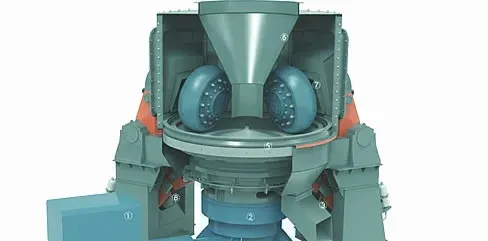
VRM grinding roller in high-chrome white iron
The profile geometry must match the grinding table curvature for even pressure distribution across the grinding bed
Grinding Roller Material Comparison
Three material systems are used for VRM grinding rollers. The choice depends primarily on the raw material abrasion index (AI), operating temperature, and whether the roller is being supplied as a new casting or rebuilt from an existing core.
| Werkstoff | Härte | Abriebfestigkeit | Thermische Stabilität | Beste Anwendung |
|---|---|---|---|---|
| High-Chrome White Iron (Cr15Mo3 / Cr20 / Cr26) | 58–64 HRC | Excellent | Good (to ~300°C) | New rollers for high-AI raw materials: quartz-bearing limestone, slag, mineral ore |
| Ni-Hard 4 (Ni-Cr white iron) | 54–58 HRC | Very Good | Good (to ~350°C) | New rollers for moderate-AI feeds, higher-temperature applications (coal, hot clinker grinding) |
| CCO Hardfacing (Chromium Carbide Overlay) | 58–65 HRC | Excellent (overlay layer only) | Very Good (overlay withstands thermal cycling) | Roller rebuilds, extending roller life between full replacements, field-applicable |
| Ceramic-Reinforced Composite | 62–68 HRC (ceramic phase) | Outstanding | Good (to ~250°C) | Extreme-AI applications where roller life is the dominant cost driver. Limited availability. |
High-Chrome White Iron
High-Chrome White Iron (Cr15Mo3 / Cr20 / Cr26)
Ni-Hard 4
Ni-Hard 4 (Ni-Cr white iron)
CCO Hardfacing
CCO Hardfacing (Chromium Carbide Overlay)
Ceramic Composite
Ceramic-Reinforced Composite
Hardness values represent the as-heat-treated condition. Actual hardness depends on section thickness, cooling rate and alloy composition. CCO overlay hardness refers to the deposited surface layer; the base casting retains its original properties.
Understanding Hardness and Wear Resistance in VRM Rollers
In VRM applications, hardness correlates more directly with abrasion resistance than in crusher parts, because the wear mechanism is predominantly compressive abrasion with minimal impact. Higher carbide volume fraction in the microstructure (controlled by chromium content and heat treatment) generally means longer roller life in abrasive feeds. However, increasing hardness reduces fracture toughness — a concern for rollers subject to vibration from uneven material beds or tramp metal events.
Operating Conditions That Affect Roller Material Selection
Raw Material Abrasion Index (AI)
The single most important factor. High-quartz feeds (AI > 15) demand high-chrome or CCO. Low-quartz limestone (AI < 8) may perform well with Ni-Hard.
Operating Temperature
Coal mills and hot gas applications (>150°C) favour Ni-Hard 4 or CCO overlay for thermal stability. High-chrome Cr26 maintains hardness to ~300°C but can be brittle under thermal shock.
Feed Moisture and Variability
Wet, sticky feeds increase bed instability and roller vibration. Tougher alloys (Ni-Hard) tolerate vibration better than brittle high-chrome grades.
Maintenance Strategy
If the plant prefers to rebuild rollers between full replacements, CCO overlay is the primary option. If rollers are replaced outright each shutdown, solid castings offer a uniform wear profile.
Grinding Roller Selection Guide
1 Step 1 — Select Base Material by Raw Material Abrasion Index
| Aufgabematerial-Abrasivität | Abrasionsindex | Empfohlener Werkstoff |
|---|---|---|
| Low (pure limestone, soft clay) | AI < 8 | Ni-Hard 4 or High-Chrome Cr15 |
| Medium (limestone with quartz, mixed raw meal) | AI 8–15 | High-Chrome Cr20 or Cr26 |
| High (quartz-rich, slag, mineral ore) | AI 15–25 | High-Chrome Cr26 |
| Very High (iron ore, abrasive slag, certain mineral concentrates) | AI > 25 | High-Chrome Cr28 or Ceramic Composite (where available) |
2 Step 2 — Adjust for Temperature, Moisture and Maintenance Strategy
| Bedingung | Anpassung |
|---|---|
| Operating temperature >150°C (coal mill, hot clinker) | Consider Ni-Hard 4 or CCO for improved thermal stability |
| Frequent roller vibration (wet/sticky feed, bed instability) | Favour Ni-Hard over high-chrome for better fracture toughness |
| Roller rebuild between shutdowns (extend campaign between replacements) | CCO hardfacing is the primary option |
| Very large rollers (>2m diameter) requiring uniform hardness | Section thickness affects cooling rate — confirm alloy with foundry |
These are general guidelines. Abrasion index values vary by raw material source and should be confirmed by laboratory testing. Contact ATF with your raw material analysis and mill operating data for a specific recommendation.
Not Sure Which Roller Material?
Send your raw material analysis, mill model and current roller wear measurements. ATF will recommend the right alloy and confirm dimensional compatibility with your mill.
Lead Times for VRM Grinding Rollers
| Teiletyp | Typische Lieferzeit | Hinweise |
|---|---|---|
| CCO Hardfaced Rebuild (customer supplies core) | 4–6 weeks | Depends on roller size, number of rollers, and overlay specification |
| New Solid Casting (high-chrome or Ni-Hard) | 10–14 weeks | Includes pattern making (if new), casting, heat treatment and machining |
| New Solid Casting (existing pattern) | 8–12 weeks | Shorter when ATF holds pattern from previous order |
| Roller Segments (for segmented roller designs) | 8–12 weeks | Per segment set, varies by number of segments |
Lead times are indicative and depend on current production schedule, roller dimensions and alloy. Contact ATF with your shutdown date for a confirmed delivery schedule.
Planning a Mill Shutdown?
Order rollers, table segments and auxiliary parts together for your planned maintenance window. Combined orders ensure dimensional compatibility and can reduce total lead time.
Grinding Roller Materials in Detail
High-Chromium White Iron (Cr15–Cr28)
High-chromium white iron is the most widely used alloy family for VRM grinding rollers. The microstructure consists of a matrix of martensite (or sometimes austenite, depending on heat treatment) reinforced by a network of chromium carbides (M7C3 type). Chromium content controls the volume fraction of these carbides: Cr15 grades contain approximately 15–20% carbides by volume, while Cr26–Cr28 grades can reach 30–35%. Higher carbide fractions resist abrasion more effectively but reduce fracture toughness.
In cement raw meal applications with moderate abrasion (AI 8–15), Cr20 grades offer a practical balance of wear life and toughness. For high-quartz feeds (AI > 15) or slag grinding, Cr26 provides significantly better abrasion resistance. The Cr28 grade is reserved for extreme applications where roller life is the dominant operating cost and the feed is consistently abrasive without large tramp metal risk.
When NOT to use high-chrome
High-chrome white iron is brittle under impact loading. If the mill experiences frequent vibration trips from bed instability, wet feed or tramp metal, consider Ni-Hard 4 for improved fracture tolerance.
Ni-Hard 4 (Nickel-Chromium White Iron)
Ni-Hard 4 (also classified as ASTM A532 Class I Type D) is a nickel-chromium white iron that combines moderate carbide content with improved fracture toughness compared to high-chrome grades. The nickel addition stabilises the martensitic matrix and improves thermal fatigue resistance, making Ni-Hard 4 better suited to applications with temperature fluctuations or intermittent loading.
Ni-Hard 4 is widely used in coal mill rollers where operating temperatures routinely exceed 150°C and thermal cycling during start-up and shutdown stresses the roller surface. It is also a practical choice for moderate-AI raw meal (AI < 12) where the additional toughness provides a safety margin against vibration-induced cracking that could occur with high-chrome alternatives.
When NOT to use Ni-Hard
Ni-Hard 4 does not match high-chrome iron for abrasion resistance in high-AI feeds. For quartz-rich limestone (AI > 15), the faster wear rate of Ni-Hard compared to Cr26 will reduce campaign length and increase shutdown frequency.
CCO Hardfacing — Chromium Carbide Overlay for Roller Rebuilds
CCO hardfacing deposits a layer of chromium carbide-rich alloy onto the roller surface using submerged arc welding (SAW) or open-arc processes. The deposited layer typically achieves 58–65 HRC with a high volume fraction of primary chromium carbides. Overlay thickness is adjustable — typically 6–15 mm per pass, with multiple passes for deeper rebuilds — allowing the roller profile to be restored to its original geometry.
Hardfaced rebuilds extend the useful life of a roller casting between full replacements. The base casting provides the structural core while the CCO overlay provides the wear-resistant grinding surface. This approach is typically more cost-effective than replacing the entire roller, provided the base casting is free of structural cracks. The overlay alloy can also be adjusted: higher-chromium formulations for more abrasive feeds, or vanadium-alloyed overlays for improved high-temperature performance.
Rebuild vs Replace Decision
Rebuild economics depend on the condition of the base casting. If the core has fatigue cracks, internal porosity or has been rebuilt multiple times, the overlay cannot restore structural integrity. ATF can inspect worn rollers and advise on rebuild viability.
VRM Grinding Roller Gallery
High-chrome, Ni-Hard and CCO hardfaced grinding rollers manufactured to OEM specifications for all major VRM brands.
Need Grinding Rollers for Your VRM?
Whether you need new solid castings, hardfaced rebuilds, or segmented roller sets — send your mill model and drawing references for dimensional confirmation and material recommendation.
Request Roller QuoteVRM Grinding Roller Maintenance and Replacement
When to Replace or Rebuild VRM Rollers
Roller replacement timing depends on the wear profile deviation from the designed geometry. Most VRM manufacturers specify a maximum allowable wear depth or profile deviation beyond which grinding efficiency drops unacceptably. The plant should monitor:
Roller Profile Measurement
Measure the roller grinding surface profile at each shutdown. Compare against the design profile to quantify wear depth and shape deviation.
Mill Vibration Trend
Increasing vibration often correlates with roller-table profile mismatch. Sustained high vibration accelerates fatigue damage in both rollers and the hydraulic system.
Specific Energy Consumption
As roller and table profiles deviate from design, the mill requires more energy per tonne of product. Rising specific energy is an indirect measure of wear severity.
Product Fineness Control
Difficulty maintaining target product fineness (residue on 90 μm or 45 μm sieve) at constant classifier settings suggests the grinding contact zone is degraded.
Rebuild vs Replace — How to Decide
| Faktor | Aufarbeitung | Ersatz |
|---|---|---|
| Base casting condition | Sound — no structural cracks | Cracked, porous or deformed |
| Campaign target | Extend to next major shutdown | Full campaign (new geometry) |
| Time available | Typically faster (4–6 weeks) | Longer lead time (10–14 weeks) |
| Profile accuracy | Good — depends on welding QC | Excellent — CNC machined |
| Alloy flexibility | Overlay alloy adjustable | Fixed by casting alloy |
| Number of prior rebuilds | First or second rebuild | Third+ rebuild (diminishing base casting integrity) |
Roller Storage and Handling
Store spare rollers on dedicated cradles in a dry, covered area. Avoid stacking rollers directly on concrete floors — condensation can cause surface corrosion. Protect machined surfaces and bearing journals with anti-corrosion compound. Lift only with certified slings rated for the roller weight — never use chains directly on the grinding surface.
Empfohlene Vorgehensweisen
- Measure roller profile at every shutdown
- Monitor vibration trend and correlate with profile data
- Plan roller replacement or rebuild to coincide with table segment changes
- Store spare rollers properly to prevent surface damage
- Inspect base casting for cracks before committing to hardfacing rebuild
Vermeiden
- Running rollers beyond manufacturer's maximum wear depth
- Rebuilding rollers with structural cracks in the base casting
- Mixing new rollers with heavily worn rollers on the same mill
- Lifting rollers by the grinding surface with chains or slings
- Storing rollers outdoors without corrosion protection
Grinding Roller Compatibility by VRM Manufacturer
ATF manufactures grinding rollers for all major VRM brands. Send your crusher model and rotor drawing for dimensional confirmation before ordering.
Loesche
| Mühlenmodell | Walzen | Walzentyp | Typischer Werkstoff |
|---|---|---|---|
| LM 28.4 | 4 | Conical | High-Chrome Cr20/Cr26 |
| LM 35.4 | 4 | Conical | High-Chrome Cr20/Cr26 |
| LM 46.4 | 4 | Conical | High-Chrome Cr26 |
| LM 53.3+3 | 3+3 | Conical (M+S) | High-Chrome Cr26 |
| LM 56.3+3 | 3+3 | Conical (M+S) | High-Chrome Cr26 |
| LM 69.6 | 6 | Conical | High-Chrome Cr26/Cr28 |
FLSmidth (ATOX)
| Mühlenmodell | Walzen | Walzentyp | Typischer Werkstoff |
|---|---|---|---|
| ATOX 32.5 | 3 | Cylindrical | High-Chrome Cr20/Cr26 |
| ATOX 37.5 | 3 | Cylindrical | High-Chrome Cr20/Cr26 |
| ATOX 42.5 | 3 | Cylindrical | High-Chrome Cr26 |
| ATOX 47.5 | 3 | Cylindrical | High-Chrome Cr26 |
| ATOX 52.5 | 3 | Cylindrical | High-Chrome Cr26 |
| ATOX 57.5 | 3 | Cylindrical | High-Chrome Cr26 |
Gebr. Pfeiffer (MPS)
| Mühlenmodell | Walzen | Walzentyp | Typischer Werkstoff |
|---|---|---|---|
| MPS 3070 | 3 | Conical | High-Chrome Cr20/Cr26 |
| MPS 4000 | 3 | Conical | High-Chrome Cr26 |
| MPS 5000 | 3 | Conical | High-Chrome Cr26 |
| MPS 5600 | 3 | Conical | High-Chrome Cr26 |
Material recommendations are typical for raw meal applications. Coal mill, slag and mineral processing applications may require different alloys. Confirm material with ATF based on your specific feed and operating data.
Ordering Specifications for VRM Grinding Rollers
Every VRM grinding roller is manufactured to specific dimensional tolerances defined by the mill OEM. To confirm fit, ATF requires one of the following:
OEM Drawing Number
The OEM drawing reference (e.g., Loesche drawing number, FLSmidth part number) is the most reliable way to confirm dimensions.
Mill Manufacturer and Model
The mill make and model (e.g., Loesche LM 46.4, ATOX 42.5) allows ATF to match against our drawing library.
Customer-Supplied Drawing
If you hold your own drawings (from previous suppliers or field measurements), send them for dimensional verification.
Physical Measurement
For mills without available drawings, ATF can work from field measurements of existing rollers. Include diameter, width, profile radius and bore dimensions.
Ready to Order Grinding Rollers?
Send your mill model, drawing reference or physical measurements. ATF confirms dimensional fit, recommends the right alloy, and provides a delivery schedule matched to your shutdown.
Frequently Asked Questions — VRM Grinding Rollers
Finden Sie Antworten auf häufige Fragen zu VRM-Mahlwalzen, Werkstoffen, Auswahl und Bestellung. Nicht gefunden, was Sie suchen?
Unser Team kontaktierenWhat is the difference between a solid cast roller and a hardfaced (CCO) roller?
How does raw material abrasion index (AI) affect roller material selection?
Can grinding rollers be rebuilt more than once?
Why do some VRM mills use conical rollers and others use cylindrical?
What causes VRM roller cracking?
How do I know when to replace rollers vs rebuild them?
Werkstoffoptionen für Mahlwalzen
| Werkstoff | Typ | Härte | Angebot |
|---|---|---|---|
| High-Chrome Cr15Mo3 | Solid Casting | 58–61 HRC | Angebot anfordern |
| High-Chrome Cr20 | Solid Casting | 60–63 HRC | Angebot anfordern |
| High-Chrome Cr26 | Solid Casting | 62–64 HRC | Angebot anfordern |
| High-Chrome Cr28 | Solid Casting | 63–65 HRC | Angebot anfordern |
| Ni-Hard 4 | Solid Casting | 54–58 HRC | Angebot anfordern |
| CCO Standard | Hardfacing | 58–62 HRC | Angebot anfordern |
| CCO High-Chrome | Hardfacing | 60–65 HRC | Angebot anfordern |
| CCO Vanadium-Alloyed | Hardfacing | 60–64 HRC | Angebot anfordern |
Get a Quote for VRM Grinding Rollers
New castings, hardfaced rebuilds, or segmented roller sets. Send your mill model and requirements.
Request QuoteFordern Sie Noch Heute ein Kostenloses Angebot An
Unser Ingenieurteam antwortet innerhalb von 24 Stunden mit detaillierten Spezifikationen, Materialempfehlungen und wettbewerbsfähigen Preisen.