

Technische Eckdaten
- Material Grades
- Mn13Cr2, Mn14Cr2, Mn18Cr2
- Hardness Range
- 170-240 HB (work-hardens to 400-500+ HB)
- Weight Range
- 15-200 kg depending on crusher model
- Installation
- Drop-in replacement, no special tooling
- OEM Brands
- Metso, Sandvik, Terex, Telsmith, Symons, FLSmidth
- Standards
- ASTM A128 (manganese steel castings)
Key Features of ATF Feed Cones
Proper Distribution Angle
Feed cone profile engineered to spread material evenly around the chamber. Correct angle prevents material segregation and channeling.
Head Nut Protection
Designed to fully cover and protect the head nut from direct impact. Prevents costly damage to the main shaft assembly.
Wear-Resistant Materials
Manufactured from Mn14-Mn18 manganese steel for optimal balance of impact resistance and wear life.
Model-Specific Fit
Feed cones matched to specific crusher models. Correct fit ensures proper seating and material flow.
Easy Installation
Drop-in replacement design for quick installation during scheduled maintenance stops.
Inspection Access
Some designs allow visual inspection of head nut condition without removing the feed cone.
Feed Cones: Material Distribution and Head Protection
The feed cone sits at the top of the mantle assembly in cone crushers, serving two critical functions that directly affect machine performance and component longevity. First, it distributes incoming feed material evenly around the full 360-degree circumference of the crushing chamber, ensuring uniform loading on the mantle and concave surfaces. Proper feed distribution prevents localized overloading that causes premature liner wear, uneven product gradation, and elevated power consumption. Second, the feed cone protects the head nut and main shaft threads from direct impact and abrasive wear from falling feed material, which can drop from heights of 1-3 meters above the crusher inlet. Feed cones are cast from manganese steel conforming to ASTM A128 in grades ranging from Mn13Cr2 to Mn18Cr2, with the cone profile angle engineered to deflect material radially outward into the crushing chamber rather than allowing it to accumulate on top of the mantle.
Feed cones are sacrificial components designed to absorb impact and abrasive wear from falling feed material while protecting the more expensive head nut and main shaft assembly beneath. They are manufactured as precision castings with controlled wall thickness (typically 25-60 mm depending on crusher model) to provide adequate wear life while maintaining the correct distribution profile geometry. As the feed cone wears, its ability to distribute material evenly degrades, causing channeling where material flows preferentially to one side of the chamber. This channeling effect creates asymmetric mantle wear, reduces crushing efficiency, and can generate destabilizing forces on the main shaft. A severely worn or damaged feed cone that has worn through to the head nut exposes the main shaft threads to direct abrasion and impact, potentially requiring costly main shaft repair or replacement. ATF recommends inspecting feed cone condition at every scheduled maintenance stop and replacing when wear exceeds 60-70% of the original wall thickness or when the distribution profile is visibly distorted.
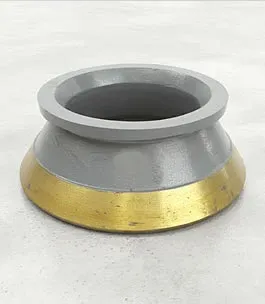
Feed cone distributes material evenly around the crushing chamber — correct geometry prevents localised liner wear
OEM Compatibility
ATF manufactures feed cones for all major cone crusher brands. Parts are engineered to match original dimensions and mounting configurations.
Metso
- HP Series (HP100, HP200, HP300, HP400, HP500, HP800)
- GP Series (GP100, GP200, GP300, GP500)
Sandvik
- CH Series (CH420, CH430, CH440, CH660, CH870)
- CS Series (CS420, CS430, CS440)
Terex / Cedarapids
- TC Series
- Kodiak Series
Telsmith
- T-Series (T300, T400, T500, T900)
Symons
- Standard & Shorthead (2', 3', 4-1/4', 5-1/2', 7')
FLSmidth
- Raptor Series (Raptor 250, Raptor 400, Raptor 900)
Need a Replacement Feed Cone?
Send your crusher model for a quote with correct dimensions and material grade.
Material Options for Feed Cones
Feed cones are manufactured from manganese steel grades selected for the specific wear mechanism—primarily impact from falling material combined with abrasive sliding wear.
| Werkstoff | Härte | Anwendung | Hinweise |
|---|---|---|---|
| Mn13Cr2 Manganese | 170-200 HB (work-hardens) | Soft rock applications with moderate feed heights | Cost-effective for lower-wear applications |
| Mn14Cr2 Manganese | 180-210 HB (work-hardens) | Standard grade for most applications | Good balance of cost and wear life |
| Mn18Cr2 Manganese | 200-240 HB (work-hardens to 500+ HB) | High-drop applications, abrasive materials | Premium grade for demanding conditions |
Mn13Cr2 Manganese
Mn14Cr2 Manganese
Mn18Cr2 Manganese
Note: Feed cone wear life varies significantly with drop height, feed rate, and material characteristics. Higher grades justified for aggressive applications.
Feed Cones FAQ
Finden Sie Antworten auf häufige Fragen zu feed cones Werkstoffen, Auswahl, Wartung und Bestellung. Nicht gefunden, was Sie suchen?
Unser Team kontaktierenHow often should feed cones be replaced?
What causes uneven feed cone wear?
Can a worn feed cone damage the crusher?
Do feed cones affect product gradation?
Technischer Inhalt geprüft vom ATF-Ingenieurteam | Metallurgische Spezifikationen verifiziert nach ASTM/ISO-Normen
Get a Quote for Feed Cones
Provide your crusher model for a quote with correct dimensions and material recommendations.
Contact ATF Engineering