

Especificaciones clave
- Material Grades
- Mn14Cr2, Mn18Cr2, martensitic (450-550 BHN), high-chrome (60-64 HRC)
- Weight Range
- 10-500 kg per hammer depending on crusher model
- Weight Matching
- Opposing hammers matched within 1-2% of weight
- Mounting
- Pin-hole with machined tolerances for OEM rotor pins
- Configuration
- Reversible and non-reversible designs
- Operating Temperature
- Standard to 400°C for clinker crusher service
Material Options for Crusher Hammers
Hammer material selection depends primarily on the balance between impact loading and abrasive wear in your specific application.
| Material | Dureza | Aplicación | Notas |
|---|---|---|---|
| Mn14Cr2 Manganese | 180-210 HB (work-hardens to 400+ HB) | High-impact applications, clinker crushing, tramp metal present | Excellent toughness, moderate abrasion resistance |
| Mn18Cr2 Manganese | 200-240 HB (work-hardens to 500+ HB) | Heavy-duty impact, demolition, hard rock | Maximum toughness for severe impact |
| Martensitic Steel | 450-550 BHN (45-55 HRC) | Balanced applications, moderate impact and abrasion | Hard as-delivered, good all-around performance |
| High-Chrome White Iron | 60-64 HRC | Clean, abrasive feeds with low impact | Maximum abrasion resistance, brittle under impact |
Mn14Cr2 Manganese
Mn18Cr2 Manganese
Martensitic Steel
High-Chrome White Iron
Note: Consult ATF engineering for material recommendations based on your specific feed material, moisture content, and throughput requirements.
Crusher Hammers: Impact Elements for Size Reduction
Hammers are the primary impact elements in hammer crushers and hammer mills, mounted on rotor pins within a spinning assembly that delivers high-energy impacts to feed material at tip speeds typically ranging from 25 to 50 meters per second. Each hammer strike transfers kinetic energy proportional to the hammer mass and the square of the rotor velocity, making both weight and speed critical parameters in determining size reduction efficiency. Hammer design geometry, including the face angle, thickness, and overall profile, directly influences product gradation, throughput capacity, and energy consumption per ton processed. ATF manufactures hammers in weights ranging from 10 kg for small hammer mills up to 500 kg for large primary hammer crushers, with every set precision weight-matched to prevent rotor imbalance that accelerates bearing and housing wear.
Material selection for hammer crusher hammers depends on the balance between impact loading and abrasive wear specific to each application, as well as the presence of tramp metal in the feed. Austenitic manganese steel grades (Mn14Cr2 and Mn18Cr2 per ASTM A128) provide excellent impact toughness and progressive work-hardening from 200 HB to over 500 HB at the striking face, making them ideal for high-impact applications such as clinker crushing, demolition recycling, and hard rock processing where tramp metal is present. Martensitic steel hammers at 450-550 BHN offer a balanced solution for moderate impact and abrasion, arriving hard as-delivered without requiring work-hardening. High-chrome white iron at 60-64 HRC maximizes abrasion resistance for clean, non-metallic feeds such as coal, glass cullet, and mineral sands, but is brittle and will fracture under heavy impact loading or tramp metal events.
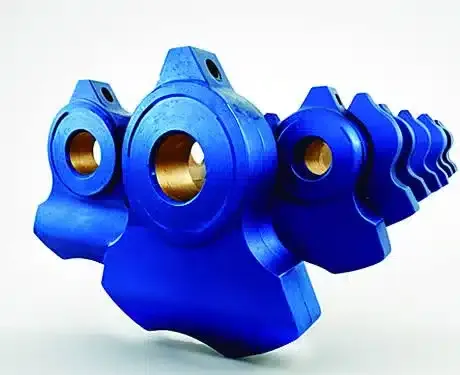
Weight-matched hammer sets in Mn14–Mn18 manganese steel and martensitic alloy for hammer crushers and hammer mills
Key Features of ATF Crusher Hammers
Application-Matched Materials
Manganese, martensitic, and high-chrome options selected for your specific feed material and operating conditions.
Precision Weight Matching
Hammer sets matched by weight to prevent rotor imbalance. Critical for bearing life and vibration control.
Hole Tolerances
Mounting holes machined to correct tolerances for proper fit on rotor pins. Minimizes wear at pin-hole interface.
Reversible Designs
Many hammer designs allow 180° rotation to utilize wear on both ends, effectively doubling usable life.
Custom Profiles
Custom hammer profiles available for specific applications or to match existing non-standard designs.
Complete Sets
Complete rotor sets supplied with consistent weight matching across all positions.
Need Replacement Hammers?
Send your crusher model and current hammer dimensions for a quote with material recommendations.
OEM Compatibility
ATF manufactures hammers for all major hammer crusher and hammer mill brands with correct weights and mounting configurations.
Williams
- Meteor, Impact Dryer, Swing Hammer
Pennsylvania Crusher
- Reversible, Non-Reversible, Ring Granulator
FLSmidth
- EV Series, Impact Hammer
Hazemag
- HPI, APS Series
Stedman
- Cage Mill, Mega-Slam
Jeffrey Rader
- Swing Hammer, Ring Hammer
Hammers Preguntas frecuentes
Encuentre respuestas a preguntas comunes sobre hammers materiales, selección, mantenimiento y pedidos. ¿No encuentra lo que busca?
Contactar a nuestro equipoHow often should hammers be rotated or replaced?
Why is hammer weight matching important?
What causes hammers to break instead of wearing?
Can I mix hammer materials on the same rotor?
Contenido técnico revisado por el equipo de ingeniería de ATF | Especificaciones metalúrgicas verificadas según normas ASTM/ISO
Get a Quote for Crusher Hammers
Provide your crusher model for quotation with correct weights and material recommendations.
Contact ATF Engineering