

Especificaciones clave
- Material Grades
- Mn18Cr2, Mn22Cr2, Mn22Cr3 (ASTM A128)
- Surface Hardness
- 200-260 HB initial; work-hardens to 550+ HB
- Segment Weight
- 500-8,000 kg per segment depending on crusher size
- Crusher Sizes
- 42-65 through 60-110 primary gyratory
- Construction
- Multi-segment with row-specific profiling
- Backing
- Epoxy or zinc backing compound, poured in-situ
Key Features of ATF Gyratory Liners
Premium Manganese Grades
Mn18 and Mn22 grades with controlled chemistry for maximum work-hardening and impact toughness.
Precise Profiling
Liner profiles engineered for specific crushing chambers. Correct geometry ensures proper crushing action and feed flow.
Segmented Construction
Multi-segment designs for practical handling and installation. Individual segments replaceable without complete liner change.
Row-Specific Optimization
Concave rows can be specified with different profiles and materials based on position-specific wear conditions.
Lifting Provisions
Integral lifting eyes or tapped holes for safe handling during installation.
Weight Certification
Individual segment weights documented for balance verification and installation planning.
Gyratory Mantles and Concaves: Primary Crusher Liners
Gyratory crusher mantles and concaves are the massive manganese steel liners that form the crushing chamber in primary gyratory crushers, representing some of the largest individual cast manganese components produced in the mining industry. Individual segments can weigh from 500 kg for smaller 42-65 units up to 8,000 kg for the largest 60-110 gyratory crushers, and they operate under extreme conditions including continuous heavy loading from run-of-mine feed at rates exceeding 10,000 tonnes per hour, oversized material from blast fragmentation, and occasional tramp metal from mining operations. These liners are manufactured from premium austenitic manganese steel grades (Mn18Cr2, Mn22Cr2, or Mn22Cr3 per ASTM A128) that work-harden from an initial 200-260 HB to surface hardness values exceeding 550 HB under the sustained compressive impact of primary crushing duty.
Unlike cone crushers where liners are typically supplied as one-piece components, gyratory crusher liners are segmented for practical handling, transportation, and installation using the overhead cranes available in most crusher houses. Mantle segments fit around the main shaft head assembly and are secured with a mantle nut or clamping ring and backed with epoxy or zinc compound to fill the void between the segment and the shaft head casting. Concave segments, also called bowl liners, are arranged in multiple rows within the top shell, with each row potentially specified with different profiles and even different manganese grades to optimize wear patterns based on the position-specific balance of impact and abrasion forces. Proper segment profiling and material selection are critical for achieving target throughput, minimizing energy consumption, and maximizing liner life in terms of tonnes processed per set.
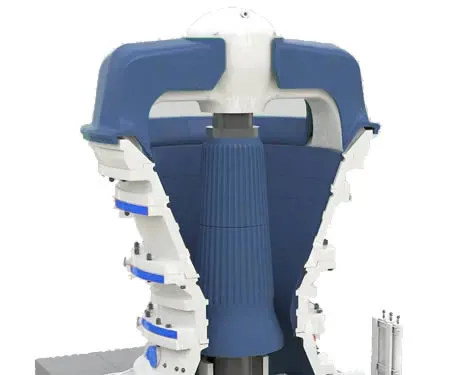
Segmented manganese steel liners for primary gyratory crushers — Mn18Cr2 to Mn22Cr3 grades for run-of-mine feed
OEM Compatibility
ATF manufactures gyratory crusher liners for all major brands with correct profiles and segment configurations.
Metso
- Superior MKII (42-65, 50-65, 54-75, 60-89, 60-110)
FLSmidth
- XL Series (42-65, 54-75, 60-89)
- TDMK Series
Sandvik
- CG Series (CG820, CG850)
- Superior Series
ThyssenKrupp
- KB Series (54-75, 60-89, 63-114)
Fuller Traylor
- NT Series
- T Series (54-74, 60-89)
Allis Chalmers
- 60-89, 54-74 Superior Gyratory
Need Gyratory Mantles or Concaves?
Send your crusher model and current liner specifications for a quote with material recommendations.
Material Options for Gyratory Liners
Gyratory crusher liners operate under extreme impact loading from oversized feed. Material selection prioritizes toughness and work-hardening capacity.
| Material | Dureza | Aplicación | Notas |
|---|---|---|---|
| Mn18Cr2 Manganese | 200-240 HB (work-hardens to 500+ HB) | Standard grade for most primary gyratory crushers | Excellent balance of toughness and work-hardening |
| Mn22Cr2 Manganese | 210-250 HB (work-hardens to 550+ HB) | Premium grade for hard, abrasive ores | Maximum work-hardening for severe applications |
| Mn22Cr3 Manganese | 220-260 HB (work-hardens to 550+ HB) | Ultra-premium grade, highest abrasion and impact | Enhanced chromium for additional abrasion resistance |
Mn18Cr2 Manganese
Mn22Cr2 Manganese
Mn22Cr3 Manganese
Note: Due to the massive size and cost of gyratory liners, material selection significantly impacts total cost of ownership. Consult ATF engineering for ore-specific recommendations.
Mantles & Concaves Preguntas frecuentes
Encuentre respuestas a preguntas comunes sobre mantles & concaves materiales, selección, mantenimiento y pedidos. ¿No encuentra lo que busca?
Contactar a nuestro equipoHow long do gyratory crusher liners last?
Should mantles and concaves be replaced together?
What causes uneven concave wear between rows?
How are gyratory liner segments installed?
Contenido técnico revisado por el equipo de ingeniería de ATF | Especificaciones metalúrgicas verificadas según normas ASTM/ISO
Get a Quote for Gyratory Liners
Provide your crusher model for quotation with material recommendations for your ore type.
Contact ATF Engineering